
The short answer
Golf looks like an upper-body sport, but a lot of the swing's force goes through your knees, and most of it lands on the lead knee, the one that's planted as you rotate through the ball. On Pathway's PGA of Canada podcast series, orthopaedic sports surgeon Dr. Jihad Abouali explained that those forces can reach three to four times your body weight. Over thousands of swings, that twisting load can wear down the meniscus and cartilage, and that's often where golfers' knee pain starts.
The knee is a hinge, but the swing rotates through it
Dr. Abouali described the knee as a hinge joint. Its main job is to bend and straighten in one plane. Ligaments and muscles crossing the joint hold it together and provide power. Inside the joint, the meniscus and cartilage cushion it and let it move smoothly.
The golf swing asks the knee to do something it doesn't do much of in daily life. When you rotate your trunk and hips, some of that rotation travels through the knee. As Dr. Abouali put it, the knee “has a lot of force going through that that it doesn't usually undertake in most day-to-day scenarios.”
Why the lead knee works hardest
Your back leg rotates a little during the swing, but the lead leg, the front leg (the left leg for a right-handed golfer), is planted, and it takes both more rotation and more force. Dr. Abouali said the forces through the lead knee can be three to four times your own body weight.
A healthy knee is built to twist and pivot, and it can tolerate that. The issue is repetition. Golfers take hundreds of thousands of swings over the years, and Dr. Abouali explained that, with that kind of mileage, the torque eventually starts to cause problems.
What thousands of swings do to the meniscus and cartilage
The meniscus. The menisci are ring-shaped cushions and shock absorbers inside the knee. They give a lot of support during rotation, especially when the knee is slightly bent, which is the position you swing from. Dr. Abouali described a process of attritional wear, or wear and tear. Repetitive twisting can create small micro tears that expand over time into larger tears. In a young, healthy knee you may never notice them. As the tissue ages and degenerates, they're more likely to surface.
Cartilage. Cartilage caps the ends of the bones and gives the joint a very smooth gliding surface. Dr. Abouali compared it to a pool cue ball. Lots of repetitive mileage can wear it away as well, and because cartilage has no blood supply, damage doesn't heal on its own. For more on that, see knee cartilage repair and early knee arthritis symptoms.
What golf-related knee pain can feel like
According to Dr. Abouali, a golfer with a meniscus tear usually has pain in one specific, consistent spot along the side of the joint, rather than an ache all around the knee. Some also notice what he called mechanical symptoms: locking, catching, or a feeling that something gets stuck in the knee in certain positions.
On the course, it can show up in two ways. During the swing, golfers may feel something sharper, or a catch, as they rotate. Walking the course and standing for long periods also loads the knee, so pain can build over the course of a round.
Cartilage problems can overlap with this. A small, localized cartilage injury may cause pain in one spot, while more widespread wear (closer to an osteoarthritis picture) tends to cause pain that's harder to pinpoint, along with stiffness and swelling. The guide to meniscus tear symptoms goes into more detail.
How golf knee pain is assessed
Dr. Abouali said the usual next step after talking with and examining a golfer is imaging. An X-ray shows the overall health of the joint and any osteoarthritis or bone problems. If a soft tissue problem like a meniscus or cartilage injury is suspected, an MRI gives a three-dimensional view that shows whether there's a tear, where it is, and whether any fragments have moved out of place.
From there, the plan depends on what's found. Smaller tears without displaced fragments are often managed conservatively, with physiotherapy or a period of rest. Displaced or unstable tears are more likely to point toward knee arthroscopy, the camera-based, minimally invasive procedure Pathway's surgeons perform for meniscus injuries, either as a meniscectomy (removing the damaged part) or a meniscal repair.
Ligament injuries: less common in golf, but they happen
The ligaments give the knee its stability, which matters with rotation. Dr. Abouali said ACL and MCL injuries are less common in golf than in many sports, but he still sees them in golfers. The MCL usually heals well with rest, bracing, physiotherapy and sometimes PRP. The ACL has little capacity to heal on its own, so if the knee is lax or unstable, an ACL reconstruction comes into the conversation. See ACL repair vs reconstruction for the difference between the two.
Use the off-season well
Dr. Abouali's off-season advice came down to two things.
First, build strength while you're golfing less. Strong quadriceps, hamstrings and glutes protect the knee, so you come back in spring with a solid foundation.
Second, don't ignore symptoms that hung around all summer. If you've had persistent pain, swelling, or locking and catching, and you got through the season on Advil and ice, he recommends getting checked by a sports medicine or orthopaedic surgeon. An examination and investigations can show whether there's an underlying injury that's worth treating now, so you can return to golf in the spring.
What Dr. Abouali said on the podcast
“Your lead leg actually has even more force and rotation on it because that's the one that's planted.”
“Those forces can be even three to four times your own body weight going through the knee on your lead leg.”
“Eventually that kind of torque through the knee can start to cause some issues.”
Watch this part of the episode
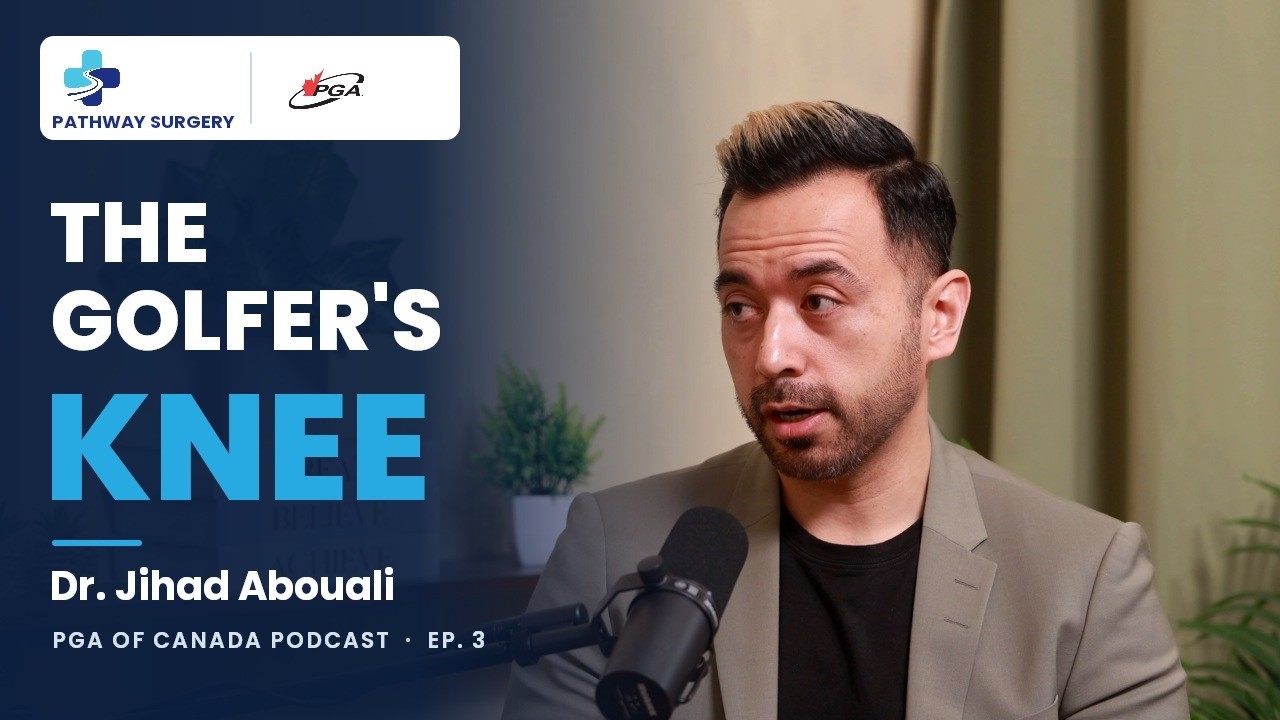
Dr. Abouali explains how the swing loads the knee starting at 0:59. The “three to four times body weight” point is at 2:52, and his off-season advice starts at 35:12. This is Episode 3 of Pathway's PGA of Canada series, with host Nino Nikolovski.
Frequently asked questions
Why does my front knee hurt after golf?
Your front (lead) knee is planted during the swing and takes more rotation and force than your back knee. Dr. Abouali said that load can reach three to four times body weight, and over time it can wear the meniscus and cartilage.
Can golf cause a meniscus tear?
It can happen with a single forceful twist or through repetition. Dr. Abouali described repeated torque leading to small micro tears that can grow into larger tears over time, especially as the tissue ages.
Should I keep playing through knee pain?
Dr. Abouali's advice was not to ignore pain, swelling, locking or catching that persists, especially if you've been managing it with painkillers and ice. Some injuries are easier to treat when they're caught early.
Are ACL injuries common in golf?
Less common than in many sports, according to Dr. Abouali, but he does still see ACL and MCL injuries in golfers.
What should golfers do for their knees in the off-season?
Focus on strength training for the quadriceps, hamstrings and glutes, and get any lingering symptoms assessed so treatment, if needed, can happen before spring.
Source: The Golfer's Knee: Managing Pain and Performance, Episode 3 of the PGA of Canada x Pathway Surgery series, recorded November 1, 2026, with Dr. Jihad Abouali and host Nino Nikolovski. Clinical statements are Dr. Abouali's, as said on the episode. This article is for general education and isn't medical advice. Speak with a qualified healthcare provider about your own symptoms and treatment options. See our editorial policy.