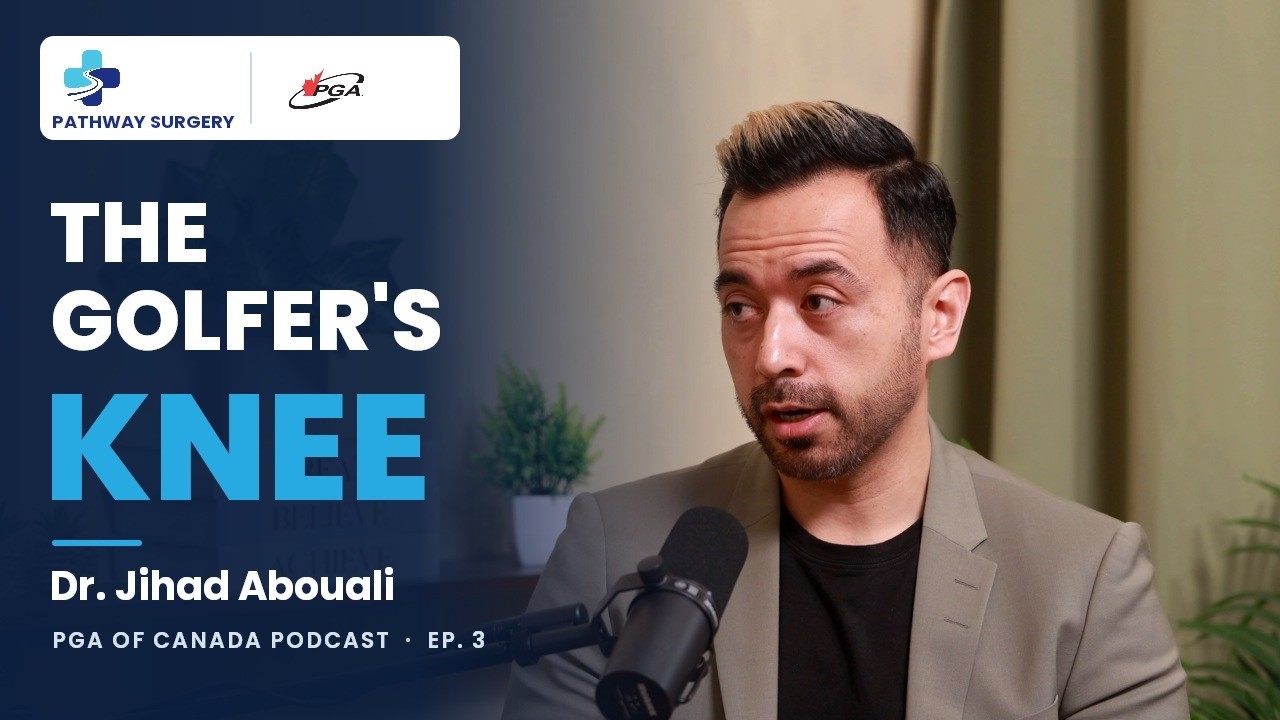
Watch on YouTube (opens in a new tab) · 37 min 14 sec
The Golfer's Knee: Managing Pain and Performance featuring Dr. Jihad Abouali
Nino Nikolovski and Dr. Jihad Abouali discuss knee pain in golfers, from meniscus tears and cartilage wear to osteoarthritis, with a practical look at knee arthroscopy, injections, recovery and what to do in the off-season.
Guest
Dr. Jihad Abouali
Host
Nino Nikolovski
Runtime
37 min 14 sec

Official Orthopedic Surgery Partner
PGA of Canada · National Partner since July 2026
About the PartnershipKey Takeaways from the Conversation
Dr. Abouali connects the rotation of the golf swing with the knee problems he sees in practice. The discussion covers the meniscus and cartilage, how they are assessed and treated, and how golfers can plan their recovery and their off-season.
1. The Swing and the Knee
The Lead Knee Takes the Load
The knee is a hinge joint, but the golf swing rotates through it. Dr. Abouali explains that forces through the lead knee can reach three to four times body weight, and how years of repetition can wear the meniscus and cartilage.
2. Meniscus Tears
Signs, Imaging and Surgery
Pain in one spot, locking or catching can point to a meniscus tear. The discussion covers X-ray and MRI, when conservative care is tried first, and when knee arthroscopy is recommended, including bucket handle and root tears.
3. Recovery and Cartilage
What Recovery Looks Like
After a meniscus cleanup, Dr. Abouali describes chipping and putting at two to four weeks and full golf at six to eight; a repair takes four to six months. He also explains cartilage restoration, from microfracture to cartilage transplants.
4. Injections and the Off-Season
Treatment Options and Timing
PRP, cortisone and hyaluronic acid injections each have a different role and timeline. The episode closes on the off-season: build quadriceps, hamstring and glute strength, and get persistent pain, swelling or catching assessed.
Related reading: knee arthroscopy and meniscectomy, meniscal repair and Dr. Jihad Abouali.
What the Series Covers
This episode is part of a monthly series produced by Pathway Surgery for PGA of Canada members. Each episode pairs one of Pathway's fellowship-trained surgeons with the questions golfers actually ask about a specific part of the body, and is timed to the stage of the season professionals are in, from peak play through the off-season.
Episodes are shared through the PGA of Canada's member newsletter and development hub. The series runs from September 2026 through March 2027; topics and release details may change.
A New Approach to Golfer Health
Kevin Thistle, CEO, PGA of Canada · Episode 1
The Golfer's Knee: Managing Pain and Performance
Dr. Jihad Abouali · this episode
Back Pain Management & Sports Longevity
From the Ground Up: Foot & Ankle Health
Hip Pain… or Is It? A Golfer's Panel Discussion
Dr. Thierry Pauyo, Dr. Sebastian Rodriguez-Elizalde & Dr. Jas Chahal
Common Injections and Biologics for Golfers
Topics and surgeons are planned and may shift as the series is produced.
The Golfer's Knee: Managing Pain and Performance — Transcript
Lightly edited from the recording for readability. Refer to the recording for the original spoken wording.
Speakers: Nino Nikolovski, host, and Dr. Jihad Abouali. Recovery estimates are part of the conversation and vary with the injury, procedure and individual care plan.
Introduction and the knee in golf
Nino Nikolovski: Welcome back to another episode of the Pathway Surgery Podcast. I'm your host, Nino Nikolovski. And today we have a special one with a collaboration with the PGA of Canada. And I'm pleasured to be joined by Dr. Abouali here in the studio today. Dr. Abouali, how's it going? And can you introduce yourself a little bit to the PGA of Canada members?
Dr. Jihad Abouali: Thanks, Nino. It's going great. So my name is Dr. Jihad Abouali. I'm an orthopedic sports surgeon based in Toronto. And so my practice involves a lot of shoulder and knee sports related injuries.
Nino Nikolovski: Fantastic. So today we have a great one. We're really going to focus all around the knee, which we know is fundamental to golf performance, both on the performance side of things and maybe also some injuries. So just to kick it off for today, can you discuss the knee joint a little bit, its structures, and why is it so fundamental to golf performance?
Dr. Jihad Abouali: Absolutely. So the knee joint is a hinge joint, meaning it moves in one plane, which is flexion, bending knee and extension. So straighten your knee. That is the primary movement of the knee. It is stabilized or held together by the ligaments crossing the joint and the muscles crossing the joint, which allow you to have power and action of that articulation. And there's a lot of structures within the joint that help to cushion it and allow it to move very smoothly. So that would be your meniscus and your cartilage. Right.
Nino Nikolovski: And in terms of the demands of the golf swing, particularly on the knee, can you go a little bit into that so we can look at maybe what happens when things go wrong or gets pushed too far? What are those demands like on golfers?
Dr. Jihad Abouali: Sure. So a lot of people do think that it's mostly through your upper body that you're swinging and golfing, which obviously is true. But people may not realize that so much force actually comes through your lower extremities and your knees. So when you are taking a swing, for example, your back leg has a little bit of rotation on it, but your lead leg actually has even more force and rotation on it because that's the one that's planted. And so because the knee, as I mentioned before, is a hinge joint and moves in sort of the forward and backward plane, when you rotate your trunk or your waist through the knee, it actually has a lot of force going through that that it doesn't usually undertake in most day-to-day scenarios. So even though it seems like mostly you're using your upper body, there is quite a lot of load that gets transferred into your lead leg during a swing. Those forces can be even three to four times your own body weight going through the knee on your lead leg. Wow.
Nino Nikolovski: So you didn't mention there, obviously the knee is responsible for that flexion extension, kind of that kicking motion. But you mentioned that rotational aspect as well. And obviously there's a lot of repetition with the golf swing. Over time, golfers are putting in hundreds and thousands of reps. What do those hundreds and thousands of reps end up doing to the body, putting that much rotational stress on the knee?
Dr. Jihad Abouali: Well, in a good healthy knee, the body can tolerate that, right? It's obviously designed to be able to twist and pivot. But as you mentioned with thousands and hundreds of thousands of reps, eventually that kind of torque through the knee can start to cause some issues. You get sort of what we call a attritional wear or wear and tear to the joint, to the meniscus. And sometimes that can lead to small micro tears, which can expand over time in your meniscus and become larger tears. So in a young, healthy joint, you would never really notice that. But over time, as we age, the tissue does degenerate, unfortunately, and you're putting mileage on it, we can start to see some issues.
Nino Nikolovski: Right. And before we kind of hop into some of the specific injuries and maybe some of the treatments for that, is there anything else aside from the meniscus that we should be considering in terms of predispositions to damage during these golf swings? Or is it primarily the meniscus that we're talking about?
Dr. Jihad Abouali: Well, the meniscus does give a lot of support when you're doing rotational movement, especially in that sort of semi-bent or flex position. But it's the same thing with your cartilage, too. It is a very smooth surface that allows nice gliding and articulation of the joint. Right. But again, with lots of mileage on it, lots of repetitive actions, especially ones that are repeated over and over, you can start to wear away at your cartilage a bit as well.
Nino Nikolovski: Right. So it sounds like we're going to kind of characterize today's talk on maybe the meniscus and some of the cartilage damage and then some treatments related to that for golfers, particularly. Yeah, that's right. Okay, fantastic. So I think we can just start with the meniscus straight off. Are you able to maybe characterize some of those meniscal injuries that might be happening? I know you talked about the word micro tears, maybe getting into some of those details.
Meniscus tears and their symptoms
Dr. Jihad Abouali: Sure. So the meniscus are ring-shaped structures within the knee. They act like cushions and shock absorbers. So your knee can rotate through it, as I mentioned, and it has a nice contouring so that the joint moves more smoothly. But with injuries, sometimes it's one forceful twist of the knee or a repetitive action. You can get tears in any part of that ring. So there's sort of the anterior horn of the meniscus, the posterior horn, so the front and back. There's a side of the meniscus, which is called the body. And there's two points on the meniscus that are anchored right into the bone on the tibia, and those are called your meniscal roots. So you can get, unfortunately, injury in any of those parts. Now, when they start as sort of micro tears, you may not really see them or appreciate them, but there can be tears within the meniscus, and sometimes those can surface over time as they expand.
Nino Nikolovski: Right. And you mentioned that the meniscus, there's different aspects to it, the anterior horn and the posterior horn, and maybe the lateral side as well. Does it matter where that injury happens in dictating maybe your approach to treatment? Are there going to be worse outcomes depending on where you get injured?
Dr. Jihad Abouali: So the ones that tend to cause more symptoms are the ones where the tear is a bit larger. Often this would be in the posterior horn or the body of the meniscus. So those ones, if they're smaller, we tend to manage sort of conservatively with a physiotherapy or rest period. But when they become larger or there's a piece of tissue that gets displaced, those are the ones that can be sort of the bad actors, the one that caused more symptoms and may cause more catching or locking type of symptoms in the patient. And those are the ones we tend to treat a bit more.
Nino Nikolovski: Definitely. And I'm sure we're going to touch a little bit on those non-surgical approaches or conservative approaches as well, but I think that perfectly transitions us into some surgical approaches maybe for meniscal injuries here. So when you have a golfer walk into your office and they're complaining of knee pain and you know it's maybe meniscal or maybe cartilaginous, what are they typically presenting with and what are their symptoms like?
Dr. Jihad Abouali: So the typical golfer that comes in with knee pain stemming from meniscus tear would certainly have localized pain. So this pain would be in a specific area on the side of the joint or the joint line. And it's very consistently in that same area. It's not that diffuse around the knee. The second thing they may experience are what we call mechanical symptoms. So that can be locking, catching or instability of the knee. So it's not that there's just pain, but they feel something get stuck in the knee or when they're in a certain position, it feels like it catches momentarily. And those can be signs of a displaced meniscus tear where there's a flap that's just not allowing the knee to move smoothly because something's getting stuck or caught in the way.
Nino Nikolovski: Right. And are these golfers typically complaining of this during the golf swing or maybe during just activities of daily living throughout their life?
Dr. Jihad Abouali: It can certainly be both. During the swing, they may notice something sharper or something catch during that rotational movement. They also may notice it walking the course and they're putting some weight on their knee and have been standing for long periods of time. The pain can certainly start to increase over that course of the game, course of the round.
Nino Nikolovski: Okay. So now they're in your office, you've established that they have knee pain and maybe it's localized. What are the next steps and what are those next discussions that you're having with the golfer to see what can be done about this?
Diagnosis and knee arthroscopy
Dr. Jihad Abouali: Well, the next step typically after talking to the golfer and examine them is to get some sort of imaging. So that would typically be in the form of an X-ray and an MRI. The X-ray is going to show us the health of the joint overall. And if there's any osteoarthritis or problems with the bone. And if we're thinking more that it's a soft tissue problem, the meniscus or the cartilage potentially, we're going to get an MRI. And that gives us a nice three-dimensional picture to look at the meniscus and soft tissues to see if there is a tear, where it's located and if there's any displaced fragments. From there, we can formulate a treatment plan. If it's a smaller tear, perhaps it's not displaced or there's no loose fragments. A conservative approach is often recommended. However, if there's a displaced tear or one of the really bad tears, which we can talk about further, that might point me more towards an operative approach.
Nino Nikolovski: Okay. And we can push the conservative approach aside for just now. Let's get into maybe some of those surgical options into those next discussions. Who would be maybe a good candidate for surgery at this point, presenting with a meniscal injury after you've confirmed it already on X-ray and MRI?
Dr. Jihad Abouali: So there's two patients that I think really would benefit from surgery, two sort of categories. One is the patient that has perhaps a smaller tear or a tear that doesn't have a displaced fragment. And they've tried a lot of conservative treatments. Maybe it's been three, six months. They're not improving. They still have very localized pain and they just can't get back to their sporting activities or perhaps it's interfering with their regular activities of daily living. That patient that has failed conservative treatment would be a candidate for knee arthroscopy or camera-based surgery to treat the meniscus. The second group of patients are the patients who come in presenting with one of the sort of worse or more unstable meniscal tears. So that would be the piece that's displaced or they have something called a bucket handle tear of the meniscus. Those are ones that you can't just wait on and see if they get better with time alone. We know they don't really improve without surgical intervention. So those are the ones that I'm a bit more aggressive treating surgically from the get-go.
Nino Nikolovski: Excellent. So use the nice fancy word there, knee arthroscopy. So that kind of thing alludes to the surgical approach that you like to take here. So can you tell the listeners a little bit about what is knee arthroscopy or this particular approach?
Dr. Jihad Abouali: Sure. So knee arthroscopy is essentially placing a small camera inside the joint through two small keyhole incisions. And that allows us to get a very up close look at the meniscus to see exactly where the meniscus is torn. And also we can treat the tear through these small keyholes as well. So it's all very minimally invasive. It's all a very minimally invasive surgery. There's very little downtime with these approaches because it's all through two small incisions. And it's really become the gold standard of care for treating meniscal injuries.
Nino Nikolovski: Right. And what does minimally invasive mean?
Dr. Jihad Abouali: Well, essentially, we don't want to have to make large open surgeries to get inside a joint. So the incision can be maybe two millimeters, three millimeters to put a tiny camera inside. And we also have very small instruments that can also maneuver within the joint. So there's no large incisions, no large recoveries for these operations.
Surgery day and recovery
Nino Nikolovski: Right. And perioperatively, can you just walk us a little bit through what is happening? What can golfers with meniscal injuries who require surgery expect in the operating room?
Dr. Jihad Abouali: Sure. So these are considered day surgery patients, meaning there's no length of stay overnight or for a few days. The patient would simply come into the hospital an hour or two before the surgery, get prepped by the nursing team, and then they do need an anesthetic. So they're either asleep under a general anesthetic or sometimes they can get a spinal anesthetic, which just numbs them from the waist down. The surgery itself would take about 15 to 30 minutes. So it is a fairly short and straightforward operation. And they would recover in the recovery room afterwards for another hour or so, and then they get to go home. Now, a lot of these patients can also walk immediately after surgery if there's no repair to the meniscus. If it's sort of just a cleanup operation, they're immediately fully weight bearing. They can walk out of the hospital. Other patients where there's a bit more of an extensive meniscal operation, such as a meniscal repair, they may need to be on crutches for a short length of time.
Nino Nikolovski: Got it. And you did mention it's a quick recovery, maybe the day that they're allowed to go home or the next day after. But I know we're approaching now the off-season in golf here. So for golfers that have undergone the surgery now, they've gone through the knee arthroscopy, what can they expect in terms of their recovery timeline? Maybe looking at the acute timeline to maybe further down the line, getting back to golf.
Dr. Jihad Abouali: Right. So again, that would depend on if they've had a partial meniscectomy, sort of a cleanup operation versus a meniscal repair. So I'll start with the simpler operation, which is just cleaning it up. Patients are allowed to fully weight-bear right away. They can bend and flex their knee as much as they can tolerate. So typically after two weeks or so, your limp is gone. Your day-to-day activities are fine. I would allow someone to return to golfing and swinging, maybe like chipping and putting after two to four weeks. And then anywhere from six to eight weeks, they can be back to golfing fully. So that is a much quicker timeline in terms of getting back to sports. If you've had a meniscal repair, that is a bit more of an extensive operation where we need to sort of slow the patient down, allow the meniscus to heal because there are some internal sutures. So for four to six weeks, they're just working on basic stretching and light strength and exercises. And then eventually we're probably looking at anywhere from four to six months to get back onto the course.
Nino Nikolovski: Right. Excellent. Those are very quick timelines, to be honest. I was not expecting that. And in terms of optimizing the recovery timelines, if they're looking at surgery and getting back to golf maybe months later, what can they be doing in the interim to optimize their recovery and ensure that they get back to their full swing?
Dr. Jihad Abouali: So we focus on rehabilitation, both in the pre and post-operative settings. So we would call that prehabilitation and post-operative rehabilitation. So coming into an operation, you do want to have as much muscular strength and tone as you can, because naturally you're going to lose some of that muscular strength after surgery. The joint can be a little bit stiff for a few weeks. So if you come in in better shape, your recovery will be easier. And then after surgery, I do have a dedicated protocol that takes you through getting the swelling and inflammation down, progressing to range of motion exercises and stretching, followed by a progressive strengthening protocol, very specific and guided towards your sport until you've achieved a full recovery.
Nino Nikolovski: Excellent. And is there anything else you'd like to cover on the meniscus for today, whether it's the injury itself or maybe some of the procedural aspects or anything moving on to cartilage?
Meniscal root tears
Dr. Jihad Abouali: Well, I think we should touch on one last injury about the meniscus that I didn't mention, which is the root tears. So I'd mentioned there's two points that anchor onto the bone. And one of the indications that I would suggest a surgery on a sort of more sooner than later basis would be a meniscal root injury. Those are the ones that we know if you've torn your meniscus root, you lose the entire function of that meniscus, which is a shock absorber effect. And these types of tears can lead to osteoarthritis if left untreated. And they can be a little bit difficult to diagnose without an MRI. So if on the MRI, do you see that there's a meniscal root tear, that is an injury that I am recommending surgery to be done fairly urgently because you can lose function of that meniscus otherwise, and it can lead to long-term problems. So that's one other type of injury that I think needs to be addressed quite promptly.
Nino Nikolovski: Excellent. Is there any other considerations in terms of the recovery timeline for the meniscal root versus the anterior posterior horn, as you mentioned?
Dr. Jihad Abouali: Yeah. So with a meniscal root tear, it would be a repair. So that would be on the longer side of the recovery, the four to six months where you need to be on crutches for a short period of time and have a bit of a longer recovery and physiotherapy period.
Nino Nikolovski: And for all of these surgeries, regardless of if it's just a cleanup or maybe this root tear, as we were discussing, what can golfers expect in terms of achieving their full strength and power in their golf swing in that four to six months post-operative period?
Dr. Jihad Abouali: Right. So these are joint-preserving surgeries. We are really trying to allow patients to get back to their full capacity and full strength. So the expectation is that they return fully pain-free, no swelling, and good power in their joint. Everyone's going to progress at a slightly different rate, of course, but that is the goal of the surgery. We are trying to get them back to their original form and function.
Nino Nikolovski: Excellent. That's a good spot to maybe transition into the cartilage that we mentioned as the other important aspect here that's under a lot of stress with a lot of repetition over many years. So can you tell us a little bit about the cartilage function in the knee and then what happens when it goes wrong?
Cartilage, osteoarthritis and restoration
Dr. Jihad Abouali: Yeah, sure. So cartilage is similar to the meniscus in that it is made out of collagen. It is a very strong structure within the knee that sort of caps the ends of the bone, and it is very smooth, almost like a pool cue ball. Unfortunately, however, there can be wear and tear to the cartilage over time. And the reason that is, is because we're using it, we're active, and unfortunately, there's no blood supply to cartilage. So when you do get some damage in the cartilage, there's no capacity for it to heal itself. So when it's a small injury, you may not notice it because you still have a lot of cartilage left. But once that injury has started, it does progress over time. And there can be injuries from trauma. You have a twisting injury to the knee or you fell. And the other way people lose their cartilage is just through a process called degeneration or degenerative joint disease, which is what we call osteoarthritis. And that is just a process of aging and the cells not being as healthy. And so it does start to thin and wear down.
Nino Nikolovski: Okay. And we discussed what a meniscal tear would present as maybe that's not a localized joint line pain. What do golfers that come in into your office with cartilaginous findings, what are they complaining about?
Dr. Jihad Abouali: So there can be some overlap in the symptoms if the cartilage injury or lesion is localized or located in just one particular area, then they would have localized pain in that one spot of the knee. However, as it becomes a little bit more diffuse or spreads across a joint, get into a bit more of that osteoarthritis picture, then the patient can have poorly localized pain or diffuse generalized pain. They can have some stiffness and swelling in the joint as well.
Nino Nikolovski: Okay. So now this golfer comes into your office and you've done your physical exam and your assessment. What are maybe some of those next steps and next conversations that you're having to maybe establish a treatment plan going forward?
Dr. Jihad Abouali: So again, it would depend on the extent of the injury, whether it's localized or more diffuse. So for the localized injury, we've diagnosed that on an x-ray and an MRI, then there are cartilage restoration surgeries where we can either regrow or re-implant new cartilage. Of course, this would be all after someone's failed some conservative treatment, but if it's an injury that has not improved with time or physiotherapy, we start to look at ways of how we can put some cartilage back. And there's other ways we can stimulate the patient's own knee to regenerate their own cartilage. Or in cases where it's a little bit too large of a lesion, there's ways we can implant cartilage back into the
Nino Nikolovski: knee. Okay. Maybe let's touch on both of those things and all of those things here. So what are those approaches for maybe cartilage restoration for those patients that would qualify for that?
Dr. Jihad Abouali: So let's start with a lesion where the rest of the knee is quite healthy, but there's just one spot that has a defect, almost like a pothole in the road. There's two ways we can fill that in. One, stimulate the bone in that pothole area to regrow its own cartilage. That's called a microfracture procedure. So I make tiny little holes in the bone, which allows the stem cells from the bone marrow to come and fill up that void and eventually get replaced by new cartilage. Now it's not the same as the original cartilage the patient once had. It's sort of a substitute cartilage, what we call fibrocartilage. But that is a really good way to fill in a void when it's a small lesion, right? When we get into larger lesions, the capacity for the body to fill in that void becomes less and less. So now we have to create ways or think of ways where we can transplant bone or where we can transplant cartilage into that void. We can either take it from the person's knee on an area where they don't need it and transplant into the area where they do need it. That's called an OATS procedure. Or we can take it from a donor where we get a large piece of cartilage to implant into that pothole, especially for the bigger, bigger lesion.
Nino Nikolovski: Very cool. And I know you mentioned when we were talking about osteoarthritis that it's a degenerative disease and maybe associated with aging here. But what is the kind of age spectrum that this can present with? Can early golfers and or young golfers expect to have these conversations with you in their office? Or is it mainly restricted to older golfers? For osteoarthritis?
Dr. Jihad Abouali: Yes. So there's a large genetic component with osteoarthritis. So if parents of these golfers had osteoarthritis when they were younger in their 40s or 50s, unfortunately, the golfer can expect to develop arthritis at the same age. If their parents had good knees until their 80s, hopefully the patient will have good knees until their 80s as well. So there is a large genetic component that will give you a rough estimate of when you may start to develop osteoarthritis. Unfortunately, you can see it a little bit earlier than your parents may have if there was injuries to the cartilage, sporting injuries, fractures, and that can accelerate the arthritis, what we call post-traumatic osteoarthritis. So you can get it really in any age range. I see arthritis in people in their 20s, lots of sports injuries, or perhaps some trauma and fractures, and other people it didn't really present until their 70s or 80s.
PRP, cortisone and hyaluronic acid injections
Nino Nikolovski: And I think for now, I'd like to transition out of the cartilage restoration into maybe some non-surgical approaches in terms of injections. I know this is a big area of sports medicine and sports surgery here. So can you tell us a little bit about the role of injections in managing golfer's injuries and their treatment plans?
Dr. Jihad Abouali: Yeah, absolutely. So if I'm trying to start off with a conservative approach where I don't think there's a strong indication to proceed with surgery, injections can be a very important treatment that I'd advocate or utilize to treat these injuries for both the meniscus and the cartilage. And there's a few different types of injections we use. Some of them are a bit more traditional. They're a bit more cutting edge. But injections can play a role in improving patient symptoms, and in some cases, can help with tissue healing.
Nino Nikolovski: And I know this one is thrown around a lot, maybe on the media. You guys have seen it, but PRP, so platelet-rich plasma. Can you tell us a little bit about that? What is it?
Dr. Jihad Abouali: Sure. So platelet-rich plasma is one of those newer cutting edge injections that we're using in sports medicine and injuries. So the process of PRP or platelet-rich plasma involves taking a patient's blood, a sample of their blood, and spinning it in a centrifuge. That centrifugation process separates the cell layers so that we can take the platelets and the plasma. Those platelets and plasma have a lot of your growth factors and anti-inflammatory factors that can help with tissue healing, changing the biologic environment of a joint to allow for better modulation of the inflammation, and in some cases, regeneration of tissue.
Nino Nikolovski: So for these golfers that come in and maybe a surgical approach is not ideal, who might be a good candidate for a PRP approach?
Dr. Jihad Abouali: So I think anyone that does not need surgery can benefit from PRP, especially if they have some degeneration in the joint or early osteoarthritis, perhaps a small cartilage lesion, or a small meniscus tear that doesn't require any surgery. What the PRP is doing is modulating the inflammation within a joint, the inflammatory cascades. It tries to stop the inflammation from occurring to reduce pain, swelling, and inflammation, and it can improve the health of the tissue, sometimes creating more synthesis of cartilage or meniscal tissue to create more strength around the joint.
Nino Nikolovski: So is this an injection that is directly injected into the knee joint or are you injecting into specific structures that might be damaged?
Dr. Jihad Abouali: So the meniscus in the cartilage is maintained within the joint capsule. It's sort of like a balloon covering of the tissue. So you inject it into the joint space, which will then bathe the cartilage and meniscus in the platelet-rich plasma. So you don't inject it right into the tissue, per se. It goes within that joint, but it stays within that capsule so that it can continue to nourish those tissues.
Nino Nikolovski: Right. So now we've maybe controlled some of that inflammation and slowed down that inflammatory process. What can golfers expect in terms of a recovery timeline from PRP injections?
Dr. Jihad Abouali: It does take a little bit of time to work. It's different than, you know, for example, a cortisone injection that can work within a few days. This is more of a biological modulation. So it takes about four to six weeks for that effect to take place and for patients to notice symptomatic relief in their pain and their joint swelling and their mobility of the joint.
Nino Nikolovski: Excellent. And what are maybe some other options or other injuries that might be targeted by maybe other injection approaches? So in PRP, we spun down the plasma and we've modulated that inflammation. Are there some other non-surgical approaches or other injections that you typically do in your practice?
Dr. Jihad Abouali: The other two injections that I will still use are more traditional, but they can have a role. So that would include corticosteroids, also commonly known as a cortisone injection, or hyaluronic acid, which people often hear about having a gel injection. So cortisone is a synthetic steroid that is quite potent at reducing inflammation. So it can be good for quick, fast acting relief of joint pain. However, the downside is that it does not last very long. It can typically last anywhere from four to six weeks and then the effect wears off. And repetitive cortisone injections are not the healthiest for the joint. It can lead to cartilage degradation or thinning down of the cartilage, which is the opposite of what we're trying to achieve. So there is a limited role for cortisone, perhaps in the very flared up knee or someone needs very acute relief, but it's not something that I use for long-term pain management. The second injection is hyaluronic acid. So these are synthetically made gels that get injected into the joint. It tries to mimic our own synovial fluid in the knee. It's like a replacement of that to try and give you more viscoelastic support. So there's less shock going to the knee. There's more shock absorption. And there may be some role of reducing inflammation as well. These can last up to six months. So it's a little bit longer than cortisone, but it's variable if it works for each patient.
Nino Nikolovski: Okay. And we'll touch on each of these separately. Just starting with steroids here, mentioned in the very acute sense. So now we're November 1st, kind of end of the end of the golf season, going into the off season. Would this be something that you might consider during the season if a golfer is experiencing knee pain and maybe needs to finish off off the season as a one use injection to alleviate some of that pain?
Dr. Jihad Abouali: Correct. It's sort of like a mid-season, end of season type achievement where they just need to get to the next few weeks to finish off their season or they got a big trip coming up. They want to really enjoy that. And, you know, they're leaving in a few days. So the timeline is short. They need quick relief. That is something that I'll typically use during that time period. However, like I said, it's not a good long-term management plan. So it's not something that I would repeat periodically. And if we have more time to see them improve, I'd be thinking about one of the other injections.
Nino Nikolovski: Okay. Excellent. And then in terms of hyaluronic acid, this gel injection, who's a candidate for this? And when is it typically used when you inject it? So
Dr. Jihad Abouali: it's typically used for patients with mild to moderate osteoarthritis. The earlier in the disease process, we use it, the better the results will be. It doesn't work as fast as cortisone. It can also take a few weeks to work. And like I said, it can last up to six months. But it is much safer. There's no negative side effects from this, the way cortisone has. So it is an option for patients in sort of the very early osteoarthritic type of picture, where they may benefit from this for a short period of
Nino Nikolovski: time. Right. And because I guess it is a gel that is being injected in the knee, do you find that golfers typically experience immediate pain relief or what is the onset of the
Dr. Jihad Abouali: effect? Well, typically after any injection, you're going to get a period of soreness and maybe fullness feeling in the knee. So for a few days up to a week, it can be a little bit worse off after injection. But with hyaluronic acid, it probably takes about three weeks or so to feel the full benefit from it. So they can still golf during this time. There's no limitations, but they might not get the effect that they want to see until a few weeks later.
Nino Nikolovski: And because you use these or use hyaluronic acid specifically in mild to moderate cases, can it help prevent the progression of osteoarthritis to maybe those severe stages by giving some viscoelastic properties? Or is it just the kind of an acute treatment?
Dr. Jihad Abouali: Yeah, that is a great question. That was certainly the hope that doing these injections would reduce or slow down the rate of osteoarthritis. But unfortunately, all the research and studies behind this have shown that is not the case. So it is mostly used for symptomatic relief. It's not to prevent the progression of the disease.
Nino Nikolovski: Okay. And in those cases, maybe would hyaluronic acid then be used over a long period of time to maybe help manage those symptoms? Or would an eventual surgical approach be required?
Dr. Jihad Abouali: I think as long as it's effective, it can be repeated every six months or so. I do have patients that continue to see me for that injection every six months. And as long as it's working, meaning they get the same effect, their pain is being reduced, and they still have good function, it is safe to continue on with that. Now, as I mentioned, we're typically using this to treat osteoarthritis, right? And there's no way to slow it down with these injections. So eventually, their arthritis will progress. And there will become a point where these injections are no longer effective. We start to think of perhaps surgical alternatives,
Nino Nikolovski: right? Which those are the ones you alluded to, maybe that stem cell regeneration, going into the bone marrow, would that be accurate? Yeah,
Dr. Jihad Abouali: correct. So again, if it's sort of a focal or localized lesion, then I think those cartilage restoration procedures would be very effective for that. But if it's more diffuse osteoarthritis, meaning it's not just one pothole, the entire road has been worn down. The tires of your car have been worn down completely. You can't just fix one little patch anymore. You're thinking more of fixing the whole knee.
Ligament injuries and why timing matters
Nino Nikolovski: So I mean, so far, we've covered surgical approaches with the variety of meniscal injuries with the knee arthroscopy or the minimally invasive scope procedure, maybe some non-surgical approaches with the PRP, the hyaluronic acid, and the cortisone injections. Is there anything else typical in your practice when you're thinking about knee pain that you would like to share with the PGA tour golfers?
Dr. Jihad Abouali: Well, you know, there's certainly, we've covered two major structures that give the knee a lot of cushioning support, which is the meniscus and cartilage. The third thing that I think is very important for a structurally sound knee that's active in sports are the ligaments, right? So MCL injuries, ACL injuries, these are two very common injuries I see in all kinds of sports, but it's not exclusive or, you know, it's not that it can't happen in golf. It's less common even in the injury, but sometimes I do see these injuries presenting golfers as well. And those ligaments are so important to give the knee a lot of stability, especially with the rotational movement that I mentioned. So those are injuries that I will less commonly see but still treat in a golfer as well.
Nino Nikolovski: And do both of those also have non-surgical and surgical management?
Dr. Jihad Abouali: Yep. So usually for an MCL that is ligament that can heal quite well on its own. So that's usually a period of rest, bracing, physiotherapy, sometimes PRP injections to help the tissue heal. An ACL injury, unfortunately, usually requires surgery. It is a ligament that does not have a lot of healing capacity on its own. So if patients do present with joint laxity or instability of the knee, then we start to consider an ACL reconstruction.
Nino Nikolovski: And just a kind of a broader idea here. I know you talked about it with the root tear of the meniscus in terms of being very immediate and we should address it as soon as we're able to. But in all of these cases kind of put together, are there consequences to delaying treatment in golfers who are looking to get back to their game and pushing through their knee pain?
Dr. Jihad Abouali: Yes, absolutely. So unfortunately for those injuries that I think do need urgent surgery, so that would be the meniscus root tear, a very badly displaced meniscus tear, such as a bucket handle tear, or an injury to the cartilage where it's still contained as just a pothole and it hasn't really expanded. There are consequences to waiting and delaying treatment. So for the meniscus, let's start with the root tear. If you don't repair that root, you are essentially losing the entire joint shock-absorbing function of that meniscus, right? And the onset of osteoarthritis can be quite quick after that injury if it's left untreated. With a bucket handle meniscus tear, so that's where a large piece of tissue has flipped out of place. The longer you wait, not only is that tear likely to progress, it's very hard to place that flap of tissue back in place and repair it. So those are typically tears we'd want to fix within six weeks. And finally, with the cartilage injuries, if it's a pothole, we would like to keep it as just that pothole and repair it or fill it back in. But if left untreated and you're essentially wearing down on this area of injury, it's going to expand. The cartilage around it may start to fissure or crack and then becomes a larger injury, which now perhaps we've missed the boat where we can fix that or fill it back
Nino Nikolovski: in. So it does sound like there's a time component to most of these here. And before we wrap up for today, I know we're now approaching November now, so golfers getting into the off-season. What would you recommend as a general approach to golfers in the off-season looking to maybe prevent their knee pain going forward or even seeking treatment now that they've experienced maybe knee pain throughout the middle and end of the season?
Off-season advice and closing
Dr. Jihad Abouali: Right, so first and foremost, now that they are perhaps golfing a little bit less, now is the time to focus on your strength training. There may not be as much time during the golf season to do this, but strength training is paramount to supporting and protecting the knee. So good quadriceps, hamstring, glute strengthening is going to allow more protection of that knee so when it comes time to return to golfing, they have a solid foundation. So that's the first and most important thing that I would say they need to focus on. The second thing is not ignoring those symptoms that maybe have persisted over the summer. If you have persistent pain, joint swelling, or perhaps locking and catching symptoms that never really resolved and you're not really sure what was going on, you just kind of persevered and pushed through it, popping a lot of Advil, icing all the time. You should probably get checked out by a sports medicine surgeon or an orthopedic surgeon to start with some investigations, a proper examination to see if you have one of those underlying injuries that we have talked about that perhaps need some treatment now so you can return to golfing in the spring.
Nino Nikolovski: Excellent, I mean, I think that's a pretty good place to leave it off some good good advice approaching into the offseason for the PGA members. Dr. Abouali, this has been a knee masterclass. I mean, there's been a lot of insight into that. I think the PGA of Canada members will get a lot of information out of today. So really appreciate you taking the time to do this.
Dr. Jihad Abouali: Awesome, you know, thanks so much for having me.
Nino Nikolovski: Thank you.
Dealing with a Golf Injury?
Pathway's fellowship-trained hip, knee, shoulder, elbow, spine, and foot and ankle surgeons consult in Toronto, Hamilton and Montreal and by secure video across Canada. PGA of Canada members and their families: mention your affiliation when you reach out.
This episode is for general education. It does not replace advice from a qualified healthcare professional about your individual circumstances.