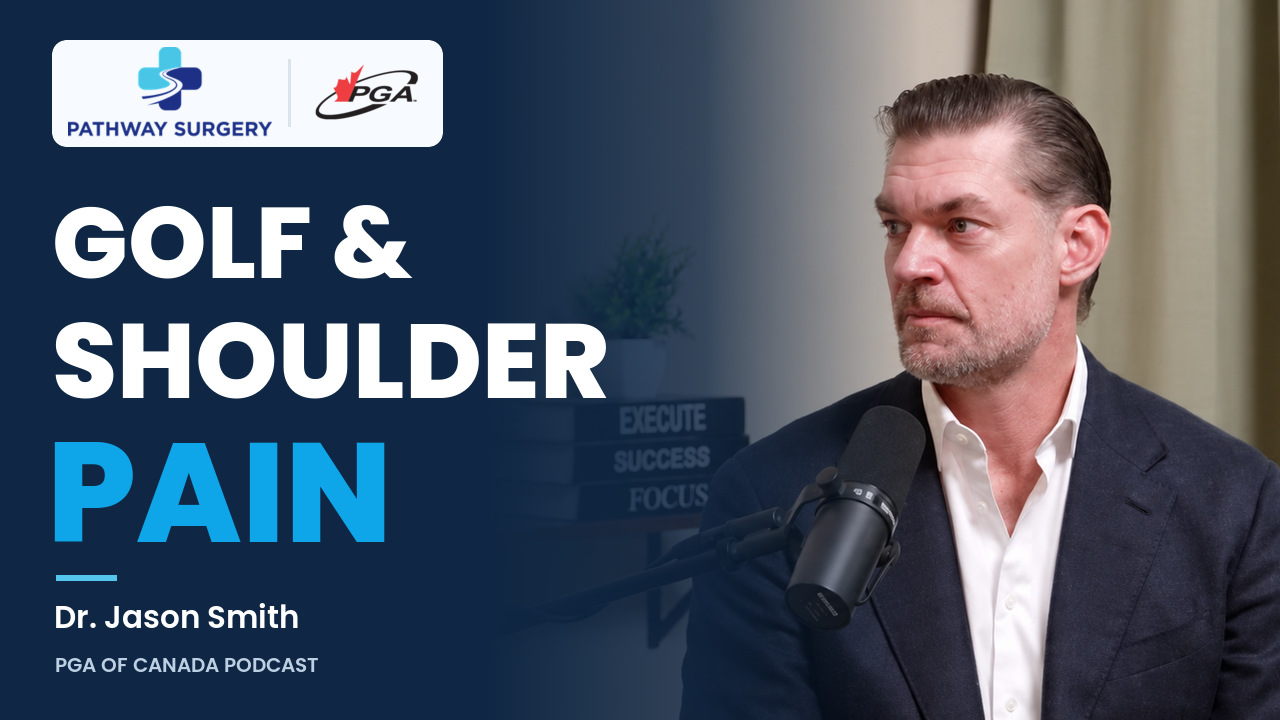
Watch on YouTube (opens in a new tab) · 34 min 31 sec
When the Golf Swing Hurts: Shoulder Pain featuring Dr. Jason Smith
Nino Nikolovski and Dr. Jason Smith discuss shoulder pain in golfers, from rotator cuff and biceps problems to impingement and AC joint arthritis, with a practical look at treatment, rehabilitation and returning to the course.
Guest
Dr. Jason Smith
Host
Nino Nikolovski
Runtime
34 min 31 sec

Official Orthopedic Surgery Partner
PGA of Canada · National Partner since July 2026
About the PartnershipKey Takeaways from the Conversation
Dr. Smith connects the demands of the golf swing with the shoulder problems he sees in practice. The discussion covers four common sources of pain and how assessment, treatment and rehabilitation fit together.
1. Understanding Pain
Four Shoulder Problems
The conversation explores subacromial impingement, rotator cuff tears, long-head biceps problems and AC joint arthritis, including where golfers may notice symptoms during the swing.
2. Treatment Options
From Assessment to Treatment
Dr. Smith discusses workload changes, swing adjustments and physiotherapy, alongside situations where injections or arthroscopic surgery may be considered after an individual assessment.
3. Returning to Golf
Recovery Depends on the Procedure
Different shoulder procedures involve different healing and rehabilitation demands. The discussion emphasizes supervised therapy, rebuilding strength and planning a return to golf with the care team.
4. Looking Ahead
Get a Clear Diagnosis
The closing discussion covers year-round consistency and why persistent symptoms deserve assessment. Dr. Smith explains how delaying evaluation can affect treatment options for some rotator cuff tears.
Related reading: rotator cuff repair and biceps tenodesis.
What the Series Covers
This episode is part of a monthly series produced by Pathway Surgery for PGA of Canada members. Each episode pairs one of Pathway's fellowship-trained surgeons with the questions golfers actually ask about a specific part of the body, and is timed to the stage of the season professionals are in, from peak play through the off-season.
Episodes are shared through the PGA of Canada's member newsletter and development hub. The series runs from September 2026 through March 2027; topics and release details may change.
A New Approach to Golfer Health
Kevin Thistle, CEO, PGA of Canada · Episode 1
When the Golf Swing Hurts: Shoulder Pain
Dr. Jason Smith · this episode
The Golfer's Knee: Managing Pain and Performance
Back Pain Management & Sports Longevity
From the Ground Up: Foot & Ankle Health
Hip Pain… or Is It? A Golfer's Panel Discussion
Dr. Thierry Pauyo, Dr. Sebastian Rodriguez-Elizalde & Dr. Jas Chahal
Common Injections and Biologics for Golfers
Topics and surgeons are planned and may shift as the series is produced.
When the Golf Swing Hurts: Shoulder Pain — Transcript
Lightly edited from the supplied transcript for readability. [Unclear] marks wording that could not be confidently resolved from the supplied text. Refer to the recording for the original spoken wording. Speaker labels follow the written exchange.
Speakers: Nino Nikolovski, host, and Dr. Jason Smith. Recovery estimates are part of the conversation and vary with the injury, procedure and individual care plan.
Introduction and shoulder anatomy
Nino Nikolovski: Welcome back to another episode of the Pathway Surgery Podcast. I'm your host, Nino Nikolovski, and today we have a very special edition with the PGA of Canada. We have the privilege to be joined by Dr. Jason Smith in the studio today. Dr. Smith, how's it going today?
Dr. Jason Smith: Doing great. Good to be here.
Nino Nikolovski: Excellent. Just to give the PGA of Canada and all its members a little bit of background into who you are, do you mind giving us a little bit of context about yourself?
Dr. Jason Smith: Sure. I am a sports orthopedic surgeon. I've been operating for 20 years now, and I have extensive experience operating on the shoulder and elbow. I've seen a lot of golfers over the years. I've been fortunate enough to work with professionals. I've had a patient of mine win a PGA Tour event, to guys like me who just like to play and try to get better. So I've seen the full spectrum of golf, and I've seen all its injuries.
Nino Nikolovski: I've seen your swing, too. It's not just liking to play. It's a good swing out there.
Dr. Jason Smith: Do not swing that hard. That is not good for anything.
Nino Nikolovski: Yeah. Today's a great one because we're going to be kicking off this collaboration with the PGA with the shoulder joint, which we know is absolutely fundamental. Just to lay the groundwork for the rest of today's talk, do you mind discussing a little bit about the shoulder joint? Maybe some relevant structures involved that are important for performance, that might lead to injury down the line, and why is it so important for golf performance?
Dr. Jason Smith: The shoulder is a very interesting joint. It's a ball and socket, similar to your hip. But unlike the hip, where a lot of the stability comes from the actual shape, it's a ball that sits deep in the socket, the shoulder is more like a ball that's sitting on a plate. It's a really unconstrained joint. In the shoulder, we really rely on the dynamic stabilizers. This is your rotator cuff, your biceps. The muscles and tendons that surround the joint are essential in stability, in movement, in performance.
Nino Nikolovski: Right. When we're considering that rotator cuff, I know that term gets thrown around all the time. Can you give some insight into what that rotator cuff is, what it does, and why it's so important?
Dr. Jason Smith: The rotator cuff is a term for the four muscles of the shoulder that cross the joint. It's your supraspinatus, your infraspinatus, your subscap in the front, and your [unclear] in the back. They all come together, and they insert onto your humerus, the tendons do. They kind of come together, so it forms a cuff of tissue. This is your rotator cuff. Their role is in movement of all directions. They function in stabilizing the shoulder. They function in rotating the shoulder, and they function in elevating and all movements associated with the golf swing.
Nino Nikolovski: Right. I'm sure we're going to get more into that when we talk about some of the pathology of that as well. In terms of golf performance, what does the shoulder do in a typical golf swing? What are the expectations in a golfer in terms of range of motion and what that shoulder can do?
Dr. Jason Smith: The shoulder does it all. This is what transfers all your energy. The golf swing starts in your legs, starts on the ground, moves through your core, and then your shoulder joint transfers all that energy into your arm and then into your swing. The shoulder joint moves through a very large range of motion. It elevates, it extends, and there's a lot of rotation in it. The shoulder joint moves a lot during our golf swing. Any stiffness or parts of our golf swing that are lacking, we tend to compensate a lot with our shoulders. People that aren't rotating well through their back, the shoulder makes up for it. People whose elbow isn't coming straight, their shoulder makes up for it. We compensate a ton with our shoulders.
Nino Nikolovski: Does that large range of motion contribute to some of the injuries that we see, in its ability to move?
Dr. Jason Smith: Yeah, no question it does. Because it's such an unconstrained joint, and it moves through such a large range, and it's such a complex movement, it is quite prone to injury.
How shoulder injuries happen in golf
Nino Nikolovski: Right. Before we get into some of the injuries that can happen when things get taken too far, what are some of the mechanisms of shoulder injuries in golfers especially? What's happening in the shoulder?
Dr. Jason Smith: The more common things I hear about that golfers talk about, mechanisms of injury, there's kind of three main parts of the golf swing that we tend to see injuries on. It's right on full extension. As you can see, I'm a lefty, so when I talk about the golf swing, it's your lead arm and your trailing arm. At the end of your golf swing, it's your lead shoulder that really stretches and is transferring all of that energy from your body to your shoulder. People often feel their shoulder injuries and feel their shoulder pathology right at the top of that backswing. The other key moment is after they've struck the ball. They're really rotating with their shoulder, and this is where your trailing shoulder starts to really rotate. That's where you get the deceleration of the golf club, and all the energy that went through the ball is now decelerating. Then the third moment is that ball strike that isn't perfect. This is when you take too much grass. This is where you hit a root. You hit something you shouldn't be hitting.
Nino Nikolovski: It's my swing.
Dr. Jason Smith: That's the moment that a lot of people say, “I was feeling good, maybe had a little bit of shoulder pain, and then I just took that divot that was too big, or I was in the rough and I hit a little rock or something.” Those are kind of the three instances that people generally complain about their pain in their shoulder with a golf swing.
Nino Nikolovski: Would you say the former two instances are more chronic, in terms of chronic lengthening, versus the third one might be more acute, where they hit something and feel something suddenly? Or can that also be chronic?
Dr. Jason Smith: Absolutely. You nailed it on the head there. Most of these golf injuries are kind of this acute-on-chronic problem. It's an injury that's been smoldering for a long time. It's a tendon that's not really healthy. You'll feel that on the first and second things I was talking about, and then you have this moment where the forces are suddenly increased, where that eccentric load, that rotational load, is suddenly increased more than you usually do. That's what tends to break the camel's back.
Nino Nikolovski: Just to give the listener some insight here, what does eccentric loading mean? What is that?
Dr. Jason Smith: This is where your muscle is actually lengthening as it's contracting. We all think of a concentric load. Biceps, for example, when you're contracting, lifting your biceps. But if it's contracting as it's lengthening, this is an eccentric load. When we rapidly decelerate a club, such as it hits the ground or it hits some object, our muscles are still trying to contract, but suddenly they're [unclear]. You get that really strong eccentric load.
Nino Nikolovski: Right. When you have golfers come into your office, and you have these three mechanisms or three phases of the swing, do they complain on different parts of their shoulder where they're feeling pain, depending on at what point in the swing they're complaining?
Dr. Jason Smith: Yeah. Where they say their shoulder hurts and which part of the swing really leads me to start to think of different rotator cuff muscles. More in the backswing is that lead shoulder with the supraspinatus. As you're coming through and rotating a lot, that's more your subscap and biceps that we see really active in the front. Where it hurts and what part of the swing is the first question, the first little clue into what's going on in the shoulder.
Impingement, symptoms and non-surgical care
Nino Nikolovski: Right. I think that's a perfect transition to get into some of these specific injuries. We're going to be discussing four main injuries in the shoulder today. Not to use too much jargon right now, but we're going to go into subacromial impingement, the rotator cuff, which we talked about, the proximal biceps pathology, and then the AC joint. Starting with subacromial impingement first, just giving some context, what is that? Who might be a candidate for this procedure or this injury?
Dr. Jason Smith: Subacromial impingement is a real grab bag of terms. This is just the structures underneath your acromion, the acromion being that bone out here on your shoulder. Your rotator cuff passes under that, and all the muscles and tendons attach onto the humerus. When we talk about subacromial impingement, the subacromial space, this is your bursa, your tendons, and then the labrum and the joint itself. Generally, when those structures start to get inflamed, get irritated, this is the first part of that spectrum of disease. This is just simple impingement inflammation. As that progresses, and as things start to actually tear, that's when you get into rotator cuff tendon tears. You talk about impingement and cuff tears, these are either ends of the spectrum. It starts off as a little impingement and then finishes off as a rotator cuff tendon tear.
Nino Nikolovski: Right. It sounds like these two are related, but maybe one is at the beginning versus leading down the road. Maybe this swing continues in this way, it leads to rotator cuff.
Dr. Jason Smith: Yeah, exactly.
Nino Nikolovski: Okay. We can go into the rotator cuff tear specifically. Say someone walks into your office, the subacromial impingement has happened, leading to an eventual rotator cuff tear. What are the possible treatment options for this, and what are people complaining about when they walk in?
Dr. Jason Smith: Subacromial impingement is mostly just pain with movement of their shoulder, and in particular as you get at or above shoulder height. People say, “When I reach for something, it starts to be sore in that area,” or, “When I go to lift something,” particularly out to the side or away from your body. That's where your rotator cuff really starts to work. For example, at the end of your backswing, when you get more elevation out of your arm, people describe sometimes it can be just a dull ache, but often it's a real pinch in that position. It leads to pain in the arm, and the pain can radiate down the back of the arm quite far. It's the way the rotator cuff is innervated. When we see inflammation in the bursa, in the tendons, people describe this kind of achiness and this pain that comes down their arm.
Nino Nikolovski: Right. This happens during the golf swing, but also during regular activities throughout someone's day?
Dr. Jason Smith: Yep. Rarely does somebody just play golf. They'll feel it with lifting weights, they'll feel it with playing tennis or racket sports, and they'll feel it with golf.
Nino Nikolovski: Right. Next step here, they walk into your office complaining of these typical symptoms or this typical presentation. What are the next conversations that you're having with them to get an official diagnosis and talk about next steps?
Dr. Jason Smith: You get the history from them, and most of these can be dealt with non-surgically. You don't need to see a surgeon when you have some impingement. We always start by identifying the factors that have led to it. Is there something in your swing that you've changed? Have you increased your volume? Have you had periods of rest? The body likes to move, and tendons and joints like to be consistent. Often people, especially with golf in Canada, take their four or five months off in the winter when you can't golf here. It's when they start back up: suddenly this acute increase in workload leads to these syndromes, these tendinopathies, this impingement. So identifying what were the changes and what's been going on in their life to lead to these things, and then modifying those factors. Often it's simple: do some physiotherapy, check in with your diet. Are you getting enough protein to heal these little microtears that are happening? Specific amino acids, vitamins, and all these things that we talk about for bone and joint health in general. If you identify that and can get back on top of that, work with a physiotherapist, most of these things you can get on top of. Medically, sometimes we add some anti-inflammatories. In some situations, you can even add some injections such as PRP or cortisone. But the vast majority of these, it's key: get on early, seek treatment right away, and get on top of it so it doesn't become a rotator cuff tendon tear.
Rotator cuff tears and arthroscopy
Nino Nikolovski: Right. Maybe we can move on, unless there's something else you wanted to mention about subacromial treatment. In terms of the rotator cuff tear, you've established now at this point maybe it is a rotator cuff tear through your diagnosis, the history that you've taken with the patient. What are those next steps now looking like if these non-surgical options have not worked for the patient?
Dr. Jason Smith: It's a spectrum. Hopefully you get the inflammation out of the tendon, you get the tendon health back, and it doesn't lead to tears. But sometimes that impingement remains, and there are some simple little procedures that we often do to treat that before it becomes a rotator cuff tendon tear. A scope, where we put a little camera inside your shoulder into that subacromial space, and we clean out that inflamed bursa, clean out the tendon, take off that spur that's been maybe digging in all of those years, often alleviates those symptoms before they become a rotator cuff tendon tear. Unfortunately, at times things do continue to progress, and that's where the tendon itself starts to tear. Most commonly, that supraspinatus, which is the top of the rotator cuff, actually starts to tear off of the bone. This is the most common rotator cuff tendon we see. We hope it doesn't get there, but when it does get there, that's where the pain elevates. People complain of a lot more pain with rotator cuff tears versus bursitis. More night pain, pain that keeps them up at night, pain that prevents them from golfing, doing their sports. Then they also complain of weakness. They try to reach, they try to work out, and they can't. Now that muscle isn't functioning normally, and they get a lot of weakness. It's that spectrum from just a little bit of an annoyance to, “I can't raise my arm the same way, and I can't sleep at night.”
Nino Nikolovski: Right. You kind of alluded to it there with the scope that you went into, but for those who are unaware of this procedure, what is a minimally invasive procedure, or this arthroscopic procedure that you were alluding to?
Dr. Jason Smith: It's great nowadays. There's very little that we have to do large incisions around the shoulder, shoulder replacements being one of them. With the advent of the arthroscope, it's just this little camera. It's four millimeters wide. We do little tiny keyhole incisions. We're able to look into your shoulder, look above the rotator cuff, look into the joint, and treat all the conditions of the shoulder just through this little camera. It's two or three little holes into your shoulder. We look from the front, we look from the back, we look from the top, and we have special instruments that we can treat all of these conditions.
Nino Nikolovski: In the case where that supraspinatus has come off the bone, or in situations where it hasn't, what's the surgical approach that you like to take?
Dr. Jason Smith: For impingement, it's to go in there and take off the impinging tissue. Often the inflamed tissue has become scarred, hypertrophied, it's large, and then the spur has developed on the undersurface of your acromion. You go in there arthroscopically, remove that bursa, that inflamed tissue, take off that spur that's been digging in. It's kind of a cleanup of the shoulder joint and alleviates the impingement. Then as that progresses, the tendon itself, once it starts to tear, fortunately most of the time before it gets too far, we can fix those. The advancements in shoulder arthroscopy and the equipment are unbelievable. Every year it's changing so fast, the equipment and the anchors that we use arthroscopically. We can now drill little anchors into the bone. It's attached to thread. We weave it into your rotator cuff. We reattach that tendon back down to the bone so that your body can now heal it to restore normal function.
Recovery and rehabilitation
Nino Nikolovski: Fantastic. In terms of recovery timelines, because now I know we're kind of mid-fall here, looking at the PGA season and the golfing season, what can golfers that have gone through a subacromial impingement repair or a rotator cuff tear repair look forward to with their recovery?
Dr. Jason Smith: Interesting you said that. It's October right now. The leaves are starting to fall. This is where I see all my golfers. They've been grinding it out all season, trying to ignore their shoulder pain, trying to ignore their problems, and now they want to get back for next year. They want to do something with their shoulder that gets them back. A simple arthroscopy, subacromial impingement procedure where we're just cleaning things up: after about six weeks, you're pretty normal for your day-to-day stuff, and you're looking at about three months for full recovery. Plenty of time here in the off-season. For a rotator cuff repair, now the timeline's getting a little shorter because it's four to six weeks in a sling. It's three months before you're lifting, and it's usually four and a half to six months before I let you swing a club. Now, chipping and putting, you can start pretty early, but before I'll let you take that full swing, you have to get your strength back. It depends on the complexity of the tear. That's anywhere between six and nine months. Somebody gets their procedure done now, early October, we can usually get them back for next golf season.
Nino Nikolovski: Fantastic. Is there anything that golfers can be doing in their recovery period that can optimize that recovery? I know you mentioned that strength component. Can you walk us through what that would look like for a golfer who wants the ideal recovery from a rotator cuff repair?
Dr. Jason Smith: Therapy is everything. Therapy is absolutely everything. If you just rest, this is for a repair or even if you have a little microtear that's treated non-surgically, tendons and joints like to move. If you're just resting, your body's trying to repair it, and the tenocytes, which are the cells in the tendons, are trying to heal this, but it lays down tissue and it lays down the matrix in a very unorganized way. You want that tendon, you want these things, to heal in a nice organized fashion. That's with movement. That's actually with activity. When we talk about rest, we talk about active rest, because you need that little bit of stimulus in these muscles and these tendons to get them to heal properly. When I do a rotator cuff tendon repair, I have the patient starting physiotherapy within a day or two, right away. Get out of that sling, get moving with your therapist, with your professional, because that movement actually makes your shoulder heal better.
Proximal biceps problems
Nino Nikolovski: Fantastic. I think that's a good place to go on to the next part of the mechanisms of injury here. You talked about the trailing arm with that little bit of rotation affecting that biceps a little bit, and I think you mentioned the subscapularis in there as well. Do you want to talk to me a little bit about that proximal biceps pathology and what's happening there?
Dr. Jason Smith: That [unclear] biceps can be nasty. The biceps is a really unique muscle in that it actually crosses two joints. It crosses your elbow, and it crosses your shoulder. The biceps, “bi,” is actually two muscle heads. One of those muscle heads we talk about in the shoulder is the long head of the biceps. That muscle actually comes up your arm and crosses your shoulder and attaches to the socket. It actually attaches to the labrum in the top of your shoulder. It goes across your shoulder, goes down your arm, and goes across your elbow. If you think about the golf swing and all of the motions associated with that, that biceps is firing like crazy. As we're coming through with the golf swing, that rotation component where your subscap is firing, your subscap's right over top of that biceps tendon. It's sitting right underneath that. Both of those are really working in unison. Then at the top of your golf swing with that deceleration, that biceps is firing to help stabilize your shoulder. Biceps tendon injuries and presentation is more pain in the front of that shoulder, whereas rotator cuff, supraspinatus, is more kind of in the back. The biceps, right in the front is where people complain about that pain.
Nino Nikolovski: I think most people probably think of the biceps as just being responsible for curls, but it sounds like it takes a lot of that eccentric load, too, in the swing.
Dr. Jason Smith: Yeah, it's an extremely complex muscle.
Nino Nikolovski: Right. Again, you alluded to that anterior shoulder. If you have a golfer that comes to your office, what are they typically presenting with, complaining with, and what do those conversations look like?
Dr. Jason Smith: Mostly it's that pain in the front of the shoulder, pain with elevation of their arm. As they come across their body and reach in front, the biceps really rotates, and they complain of that sharp pain they get. Sometimes if that subscap is also partially injured, that biceps can actually rotate out of its normal natural groove and position, and they'll complain of clicking of that biceps tendon. They'll actually feel it moving around.
Nino Nikolovski: Right. Is it always that long head that's a problem, or is the short head ever involved as well?
Dr. Jason Smith: No. Fortunately, that one's fairly robust, and we rarely see problems with it. It's that long head that crosses both of the joints that's really a problem. Then in extreme situations, again, the spectrum where it's just a little bit inflamed versus it can tear all the way, that's when people talk about that Popeye deformity. You've heard of people like, “Oh yeah, I tore my proximal biceps, and now I have this Popeye deformity,” because the muscle actually comes down your arm and bunches up and gives you that appearance.
Nino Nikolovski: Right. Now the patient comes in presenting this way, and what are the conversations looking like for you to decide if they might be a surgical candidate for a proximal biceps repair, whatever the procedure is?
Dr. Jason Smith: Acutely, the interesting thing about that proximal biceps is often it tears, and sometimes you don't even need to do anything about it. Sometimes it's a relief. People will say, “I was dealing with anterior shoulder pain, and my biceps tore, and I could see this Popeye, but I kind of had immediate relief in your shoulder.” Sometimes we actually even leave the biceps tendon. But there's times where it'll tear, and you'll get this contraction of the biceps, and you have this really strong crampy pain. Also cosmetically, people don't like to have this Popeye deformity. If we can get to this early, what we do is we make just a little incision at the top of your arm, and we take that tendon, we get it out of your shoulder, and we reattach it to the top of your humerus.
Nino Nikolovski: Right. Again, with recovery timelines, what might that look like? I know we mentioned with the rotator cuff, maybe that—
Dr. Jason Smith: Yeah. Fortunately, this one doesn't take that long. After about six weeks, we're starting with some strengthening. Around three months to let somebody swing a club, and it's around four to five months usually back to full activities with that procedure.
Nino Nikolovski: Right. Fantastic. It sounds like, just to summarize, we had so far the subacromial impingement, we had the rotator cuff tear, and the proximal biceps pathology. Maybe if that subacromial impingement progressed a little bit, it becomes a rotator cuff tear on that leading arm. But on the trailing arm, it's really that biceps that we're looking at.
Dr. Jason Smith: We see more, and it can happen in both your shoulders. Like I said, all those muscles really work in unison with one another. There's five main tendons that cross your shoulder: your rotator cuff, those four, and your biceps. They're all working together. You can get a rotator cuff tendon tear on either shoulder. You can get a biceps tendon tear on either shoulder. They're all working together, both on the leading arm and trailing arm. Don't want to get too hung up on which arm it is. They all work together to stabilize that shoulder, to rotate that shoulder. So you see it in both.
AC joint arthritis
Nino Nikolovski: Right. Just to transition here, I know the shoulder is also considered the shoulder girdle, which also consists of that AC joint as well. I think if we talk a little bit about that AC joint, what it is, and what is AC joint arthritis in the first place?
Dr. Jason Smith: You see actually quite a bit of this in golfers, and it's the acromioclavicular joint, AC joint. Your acromion, which is that bone on the lateral side of your shoulder, which is the top part of your scapula, and your clavicle, the acromioclavicular, AC joint. It's where those two meet. That's that little bump that's in the front of your shoulder. Now, contact athletes, hockey players dislocate this all the time. I myself have a grade two AC joint separation. That's that little bump that you see. In golfers, often it's on that trailing arm, that trailing shoulder. As you come across, that clavicle really pinches into your acromion. That trailing arm, arthritis starts to develop in that joint, because it's an actual joint. It has cartilage. It has a little disc. It has its own little set of ligaments. You keep compressing it, keep compressing it, and then that joint wears out, becomes very painful at times.
Nino Nikolovski: Is this something that takes years to develop?
Dr. Jason Smith: Yeah, most of these things are kind of chronic, and then often it's something that sets it off.
Nino Nikolovski: Right. Does this AC joint arthritis typically present with other tendon tears as well, or is it pretty isolated to that AC joint?
Dr. Jason Smith: That is one that is pretty isolated. Now, it's all part of the constellation that we often see in people with rotator cuff or biceps pathology, but often that can just present as an isolated joint that's really irritating. In particular, when you bring your arm across your body, you get that pinching and that pain right in that joint.
Nino Nikolovski: Out of curiosity, just to give some more context here, every golfer has a little bit of a different swing. Is that what's really dictating what kind of injuries these golfers see? Is it some genetic factors? What's at play here when you're deciding what injury you're going to see after years?
Dr. Jason Smith: That's a really good question. What causes this? Is there a correct way to swing a golf club? No question. That's why it's so important to work with your golf professional and your physiotherapist, because often they can identify the different parts of your swing that are particularly irritating or causing problems. Often it's just a simple manipulation in your swing. Don't bring your arm up as far, make sure you're not bending your elbow, reach out versus coming across. That can solve these problems early. That's where your golf professional is great about helping you adapt your swing for your pathology.
Nino Nikolovski: Right. Turning back to the AC joint arthritis, when a patient walks into your room, how are you determining that they have AC joint arthritis, and who's a candidate for some treatment here?
Dr. Jason Smith: The AC joint, unlike the shoulder joint that often we need an MRI to actually see what's going on deep inside your shoulder, the AC joint is a nice joint. It's actually palpable. Often it's just as simple as, “Does it hurt right here?” If it's yes, well, you know the AC joint's involved. Then a test with cross-body [unclear], and often just a simple X-ray, you can really see the destruction of that joint and the degree of arthritis. Obviously, with an MRI, then you see the inflammation, you get an idea of the ligaments, that disc in there. But often that's not even needed. It's a pretty straightforward diagnosis.
Nino Nikolovski: Does the degree of arthritis guide whether treatment is going to be pursued either non-surgically or surgically?
Dr. Jason Smith: It's crazy. It's amazing how some people's AC joint on X-ray looks absolutely terrible, completely destroyed, grade four, and they have no complaints.
Nino Nikolovski: Yeah.
Dr. Jason Smith: The next person, it's just some subtle signs, a little bit of osteolysis starting, and they have a ton of pain. So it doesn't always correlate.
Nino Nikolovski: Right. In those cases where maybe it does correlate, what are the next conversations that you have in terms of treating either conservatively or with surgery?
Dr. Jason Smith: We always start conservatively. Can you modify your swing? Are there things you can do with your physiotherapist to alleviate getting into those positions that cause it? But sometimes that fails, and at times we'll do cortisone injections or even PRP injections to help take away the inflammation from that joint. When those aren't effective, then there are actually surgical remedies, and it's actually pretty simple. You go in there underneath it, again with that little camera, and you just shave away a little bit of the clavicle, and you shave away a little bit of the acromion. You actually make more space so that those bones aren't hitting one another. It's a beautiful little procedure. It's relatively benign in terms of you're not having to take down any of the muscles or the tendons. Just sneak into that joint. You shave a few millimeters, and it alleviates that pinching and that arthritic pain that you're getting.
Nino Nikolovski: Similar to the other procedures, what does that recovery look like? Are people getting relief right away if that space is opening up?
Dr. Jason Smith: Yeah, it's short, fortunately, because there's not a lot of trauma in the rest of the tissues associated with this. After three weeks, people are often able to do a lot of their weights, and I've seen people get back to golf in six weeks.
Recurrence, consistency and assessment
Nino Nikolovski: Fantastic. This is something I wanted to ask that encapsulates all four of the injuries that we talked about today. What about recurrence rates? How often are you seeing someone come back in your office for the same thing that might have been treated, in golfers especially?
Dr. Jason Smith: For sure, that impingement is coming on. I'll often treat patients with that impingement for years. You'll see it. They'll get on top of it with their physiotherapist. They'll be able to get back to their golf game, and then something changes, their workload changes, their swing changes, and they'll come back with it. It's often coming and going. Fortunately, with a surgery where you're taking out that bursa and you're actually making more room for the tendon, it's more of a permanent solution. But even that can come back. We're just hoping that it doesn't get to be a rotator cuff tendon tear.
Nino Nikolovski: Right. You mentioned that increased workload, and I think this is super important for the PGA pros who also have some teaching responsibilities. They're always out there as well, whether it's playing or teaching. What would you have for them as words of encouragement or advice that are going through shoulder pain and maybe an eventual surgery?
Dr. Jason Smith: With any sport, consistency is probably the most important. It's those real changes in workload, changes in activity, that result in these chronic problems that become really acute. It's working year-round. It's being on top of these things year-round and not neglecting it for half the season.
Nino Nikolovski: Right. I think this was something that you mentioned pretty quickly in all four of these. It might have been three out of four, but you said if we catch it early, we can do a better job. I wanted to directly ask, in all of these cases, are there consequences to delaying treatment or delaying surgery?
Dr. Jason Smith: Particularly around the rotator cuff. This is a tendon that tends to tear right off of the bone. If you get to this early, that tendon moves, that muscle hasn't atrophied. It's a pretty straightforward repair. What happens over time is now that tendon is not attached to anything, but that muscle is still contracting. You're still trying to move your arm. That tendon starts to work its way back further and further. Now that muscle isn't working against anything, and that muscle starts to atrophy, and over time you get fatty infiltration. There is a point of no return. That tendon can retract so far that you can't pull it over anymore, that you can't reattach it. A rotator cuff tear in particular is one of those injuries that we want to get to as soon as we can. We want to get a clear diagnosis. We want to get an MRI, see what's going on with that tendon, because if we can get to that early, it's a pretty straightforward procedure with a very reliable prognosis. But if you wait that six months, wait that year, and unfortunately with some of the challenges in our health care system, it's not till years that you see some of these, then they're just too far gone, and they can never be repaired.
Nino Nikolovski: Right. I think that's a good transition into my next question here, which is the fact that we are approaching the off-season with golf here. What would you tell golfers in that case who might have been going through some shoulder pain and are thinking about a consultation, or some other approaches that they've seen to care for their shoulder? What would you tell them? When should you go see a consultation? When should you go see yourself in the office?
Dr. Jason Smith: Get a clear diagnosis. I don't see much benefit in guessing, and your allied health professionals are excellent at this. A good sports physiotherapist, a good sports chiropractor, can often really shed a lot of light. Get in to see somebody, that's your sports med physician, your family doctor. But if there's uncertainty behind it, get a referral to an orthopedic surgeon, a sports orthopedic surgeon that deals with these shoulders, because like I said, a lot of these things, if dealt with quickly, are pretty straightforward, but they can get to the point that you can't fix them anymore.
Closing
Nino Nikolovski: Right. Dr. Smith, if there's nothing else on your end, I think that's a really good place to leave the podcast. Or if there's anything else you wanted to tell the PGA or the Pathway listeners about shoulders and shoulder health in general?
Dr. Jason Smith: No, that's great. I think we've covered a lot of great topics here today, and it's great talking to you about these very complex injuries.
Nino Nikolovski: Fantastic. Pathway and the PGA, it's been an absolute pleasure having Dr. Jason Smith here in the studio with us, learning all about the shoulder and some of its pathology and the surgical approaches. Until next time, it's been an absolute pleasure, Dr. Jason Smith.
Dr. Jason Smith: Yeah, great being here today. Thanks.
Nino Nikolovski: Thanks.
Dealing with a Golf Injury?
Pathway coordinates consultations with fellowship-trained hip, knee, shoulder, elbow, spine, and foot and ankle surgeons across Canada. PGA of Canada members and their families: mention your affiliation when you reach out.
This episode is for general education. It does not replace advice from a qualified healthcare professional about your individual circumstances.