
Q&A guide
Knee replacement FAQ
Partial vs. total knee replacement, robotic surgery benefits, and recovery expectations.
Full Q&A guideKnee · Unicompartmental
Replacement of a single arthritic knee compartment, when a partial replacement is appropriate. Meet your specialists and understand what to expect before booking.
5.0 from 250+ Pathway patient reviews5.0 from 250+ patient reviews
The knee has three compartments: the medial (inner), lateral (outer), and patellofemoral (kneecap). When arthritis affects only one compartment — most commonly the medial — partial knee replacement can resurface just that area while preserving the healthy parts of your knee.
Unlike total knee replacement, partial replacement preserves your ACL, healthy cartilage, and more of your natural bone. This results in a knee that often feels more natural, with faster recovery and fewer restrictions.
Not everyone is a candidate for partial replacement — it requires single-compartment arthritis with an intact ACL. Your surgeon will evaluate your imaging to determine if this option is right for you.
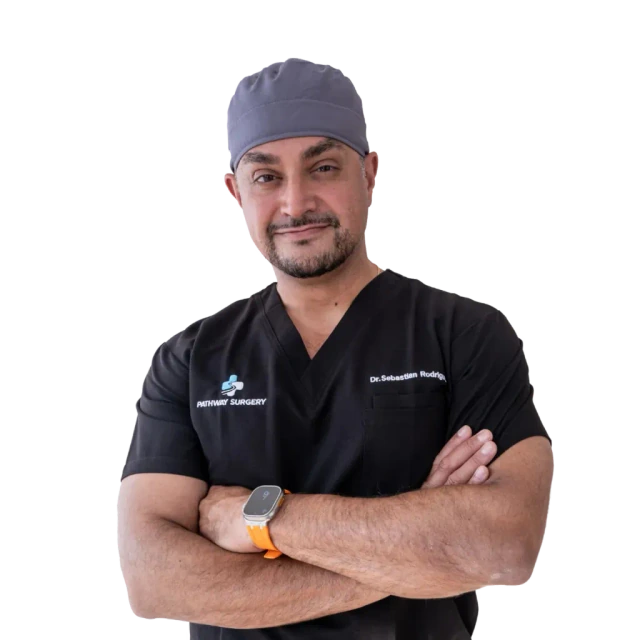
Dr. Rodriguez explains robotic knee surgery, implant options, and recovery expectations.
Partial vs. total knee replacement, robotic surgery benefits, and recovery expectations.
Full Q&A guideWho’s a candidate, robotic techniques, and what to expect from recovery.
Full Q&A guidePrecision robotic guidance for bone and ligament preservation.
Intraoperative assessment
Mako builds your plan from a pre-operative CT scan; ROSA maps alignment, joint surfaces, and range of motion during surgery
Personalized planning
Surgeon plans implant positioning specific to your anatomy while preserving unaffected compartments
Precision bone preparation
Surgeon prepares only the affected compartment with robotic guidance — ACL and healthy cartilage retained
Implant placement
The implant resurfaces only the damaged portion; motion and balance verified before final placement

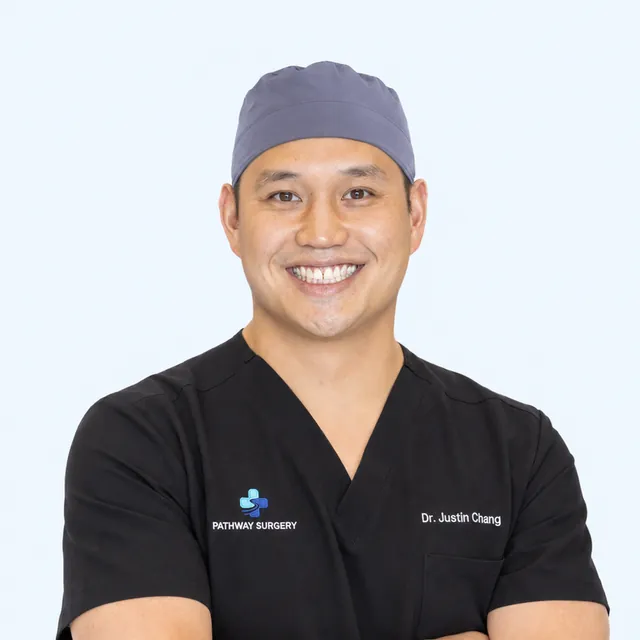
A pre-operative CT scan builds a 3D plan of your knee, and the robotic arm keeps bone preparation within the planned boundaries. Dr. Justin Chang performs his partial knee replacements on the Mako system.

Real-time guidance and verification to support accurate alignment and implant positioning while preserving your natural knee structures.

A proven implant designed specifically for unicompartmental replacement, allowing natural knee motion while addressing only the damaged area.
Partial knee replacement is ideal for patients with specific characteristics.
Most commonly the medial (inner) compartment
Stable knee ligaments are essential
Knee should still bend and extend well
Minimal to moderate alignment issues
Pain on one side of knee, not diffuse
Physio, injections, and medications haven’t helped
Not sure if partial replacement is right for you? Book a consultation and a surgeon will review your imaging.
Fellowship-trained surgeons with expertise in partial knee replacement.
If arthritis affects multiple compartments of your knee, or if your ACL is deficient, total knee replacement may be the better option. Your surgeon will discuss all options based on your imaging and examination.
Explore robotic knee replacementThe Oxford implant has shown good long-term survivorship in many patients. However, durability depends on patient activity level, weight, and how well the remaining compartments hold up over time. If arthritis progresses to other compartments, conversion to a total knee replacement is possible.
Yes, many patients experience faster recovery with partial knee replacement due to the smaller incision, preserved ACL, and less bone removal. Most patients can walk with minimal support within days and return to normal activities sooner than with total knee replacement.
Conversion from partial to total knee replacement is a well-established procedure. Because partial replacement preserves more bone, the conversion is generally straightforward if it becomes necessary in the future.
No referral is required. You can book a consultation directly. Having recent X-rays is helpful for determining candidacy, but we can arrange imaging if needed.
Schedule a consultation to find out if partial knee replacement is right for you. No referral required.


