Q&A guide
Knee sports injuries Q&A
ACL injuries, when repair may be possible, and the full recovery journey for athletes.
Full Q&A guideKnee · Ligament preservation
Ligament-preserving surgery for selected ACL tears. Your surgeon will assess whether repair is appropriate.
5.0 from 250+ Pathway patient reviews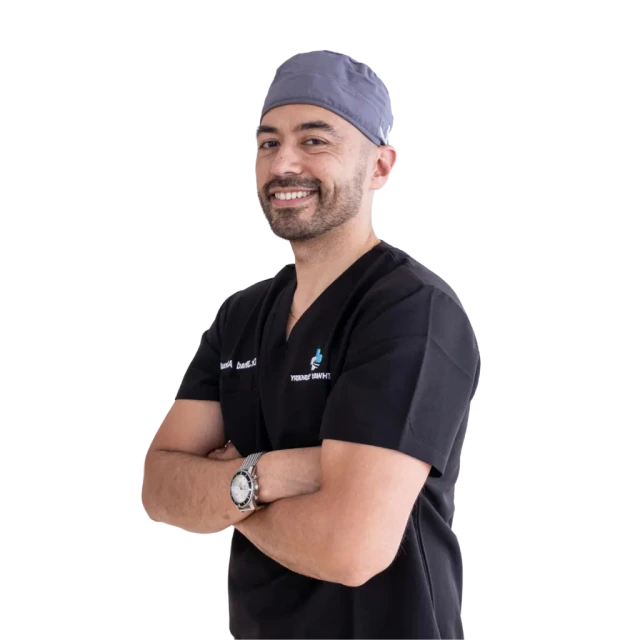
Knee & shoulder sports medicine
View surgeon profile5.0 from 250+ patient reviews
ACL repair is a ligament-preserving surgery that stitches your torn ACL back together and reattaches it to the bone, rather than removing it and replacing it with a graft.
The procedure is performed arthroscopically through small incisions. Your surgeon uses high-strength sutures to repair the torn ligament, then secures it to the bone using a special anchor. This allows your native ACL to heal in its anatomic position.
ACL repair is only suitable for certain tear types — primarily proximal tears where the ligament has pulled away from the femur. Your surgeon will evaluate your MRI to determine if you’re a candidate.
Our sports medicine specialists discuss ACL injuries, repair vs. reconstruction, and recovery.
ACL injuries, when repair may be possible, and the full recovery journey for athletes.
Full Q&A guideAdvanced anchor technology for ligament preservation.
Instead of removing your ACL, harvesting a graft, and drilling tunnels, the SwiveLock technique allows us to preserve your native ligament:
Stitch the ACL
The torn ligament is carefully sutured together using high-strength suture material
Reattach to bone
The repaired ligament is secured to the tibia using a SwiveLock anchor
Healing begins
Your native ACL heals in its anatomic position, preserving natural knee mechanics

The SwiveLock provides secure, knotless fixation that allows the repaired ACL to heal in its natural position while maintaining tension throughout the healing process.
Technology by Arthrex
Fellowship-trained in ligament preservation and sports medicine.
ACL repair is suitable for specific tear types and patient profiles.
Not sure which approach is right for you? Book a consultation and a surgeon will review your MRI.
ACL reconstruction is an excellent alternative with proven long-term success. It’s suitable for all tear types and offers multiple graft options including BTB, quad tendon, and hamstring.
Learn about ACL reconstructionNeither is universally "better"—they're different tools for different situations. ACL repair preserves your native ligament but is only suitable for specific tear types. Reconstruction works for almost all tears and has decades of proven outcomes. Your surgeon will recommend the best option for your specific injury.
Recovery timelines are similar to reconstruction—most patients return to sport between 9-12 months. The early rehab may be slightly different since you're protecting the healing native tissue rather than a graft, but the overall timeline is comparable.
If an ACL repair doesn't heal successfully, you can still undergo ACL reconstruction. Since repair doesn't involve drilling large bone tunnels, it doesn't compromise future reconstruction options. This is one of the advantages of trying repair first in appropriate candidates.
No referral is required. You can book a consultation directly with our surgical team. Having a recent MRI is highly recommended to determine if your specific injury is suitable for repair.
Preserving the native ACL is intended to maintain the natural mechanoreceptors and nerve endings within the ligament, which help provide the brain with feedback about the knee's position (proprioception). It also simplifies future surgeries if ever needed, as there are no large tunnels or graft harvest sites.
Suitability for repair depends on the tear's location and the quality of the remaining tissue. Proximal tears, where the ligament has peeled away from its upper attachment point, are excellent candidates. During your consultation, we will review your MRI imaging to provide a personalized assessment.
Schedule a consultation with Dr. Abouali to discuss whether your tear is suitable for ligament preservation. No referral required.
