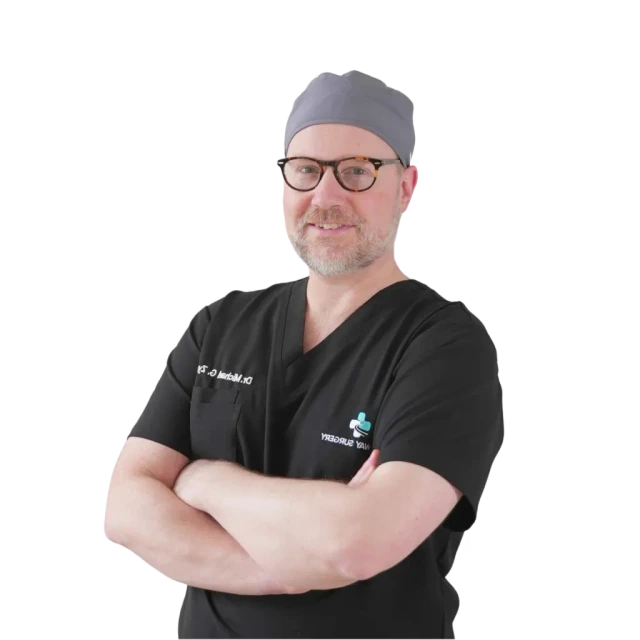
Speaker: Dr. Sebastian Rodriguez-Elizalde, orthopedic surgeon.
What is a robotic knee? What is this robotic arm, and what does it do? We're going to answer all your questions here today. My name is Dr. Sebastian Rodriguez-Elizalde. I'm an orthopedic surgeon. We're actually in Montreal in the headquarters for Zimmer Biomet and all their development. We're running a course to teach surgeons how to use the new software with our ROSA robot when we do knee replacements.
So, normally we would open up your knee. We'd go underneath the muscle and do a submuscular dissection and see the bones. This is your femur, which is the thigh bone. This is your tibia, which is the shin bone. I've gone ahead and taken the liberty of putting some pins into these bones. These pins are what anchor these arrays, and these arrays are what connect to the towers to allow the robot to see in 3D space. The first part of the operation is to attach these arrays to the femur and to the tibia down here.
The next step is to teach ROSA where all these anatomical landmarks are in the knee, to teach the computer so that the robot can make accurate decisions in terms of cutting. So the next step we're going to do here, you see the screen behind us, we're establishing the hip center of rotation. I'm going to take your leg and move it through all these poses to teach the robot where your hip is in space. I'm going to teach it where the bottom parts of the bones are. And then I'm going to use this pointer to sequentially go through a number of different anatomical landmarks throughout the knee.
This involves the side of the knee and the front of the knee. Here, I'm painting the end of the bone so we can register the most distal, or most furthest, aspect of that knee. When we do your knee replacement, I'm painting this bone so it creates a 3D model for the computer to be able to make accurate assessments of your knee. Again, we're going to teach ROSA where your shin bone is in space.
We can now determine what your leg's range of motion is. I can see how much range of motion your knee has by moving it. And here, I can put stresses on the knee to see how much laxity or looseness there is in the soft tissues. What we want to do with a ROSA knee replacement is recreate that patient's native anatomy. Not only is the arthritis gone, but the alignment feels natural to them.
So, this is the planning software, and this is really where the magic happens. This is where robotics is such a powerful tool. We can use algorithms that are pre-approved and built into this to help me make surgical decisions. I can take the components, the metal pieces, and really fine-tune how we're going to put them into your knee to make sure they're perfectly balanced. I can edit things by the degree or by the millimeter. I'm adjusting the rotation and the angles that we're going to use to make all these cuts.
Once I'm happy with our surgical plan, we can go ahead and execute. ROSA comes in and makes the cut where I've surgically planned it for your knee in a customized fashion. If the knee were to move, the ROSA arm can move to accommodate any micro-adjustments as we're doing this cut. The next part of the operation is the four-in-one guide. We're going to put these pins into the distal femur. Again, this arm is rigidly holding me in place, very accurately, right on the femur.
Now these holes, which have been accurately placed, allow us to place our cut guide into the femur. I'm going to add a couple of pins here just to hold my frontal component in place. And now we're going to make our cuts for the femur, so this is the anterior cut, the posterior cut, and the chamfer cuts, which are angled cuts to give stability to our knee replacement. We've finished our femur, which has very accurate cuts all the way across at the angles that we need to make your knee replacement perfectly balanced.
We've done the thigh bone. We're going to do the tibia, which is the shin bone. We're going to bring that robotic arm in. There's micro-motion of your leg, you can see how the robot accommodates that to make sure that cut is perfectly at the angle that I've pre-selected. This is the tibial piece that we're going to take out.
Once we're done with that, what I like to do is check our cut. As accurate as our robot is, we can use this validation tool to ensure that our cuts are perfectly aligned. Here I am on the screen, I've placed this array on the bone, and it's taking those measurements. I have all green check marks everywhere, which means that the plan we wanted to do for your knee is exactly what it is.
This is a trial component. We're going to insert this onto your knee. This is the femur, we're placing that on snug as a bug. Next is this tibial tray; we're going to place that into the knee. And these are the plastic inserts. Here we have the trial components that we placed into your knee at the angles we desired. So this is our femoral component, our tibial component, and these articular surfaces through range of motion. It tracks really well. From here, we would normally take out our practice or trial components and cement in the real ones.
And that, my friends, is how we do a ROSA total knee. Thank you for joining me today. If you have any questions, please put them in the comments below.