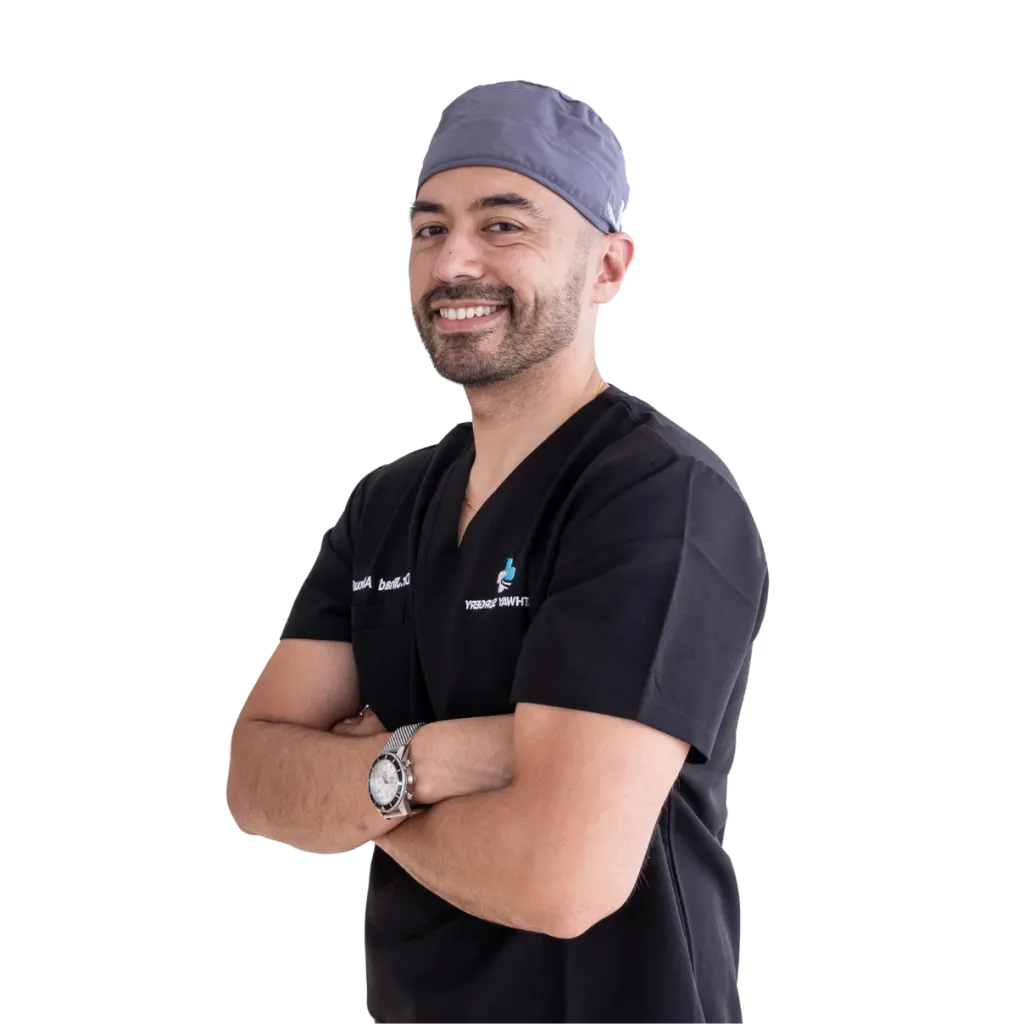
Sports medicine surgeon Dr. Jihad Abouali covers knee anatomy, meniscus tears, ACL reconstruction vs repair, graft options, and return-to-sport timelines for athletes.
The knee is a hinge joint—it basically flexes and extends just like a hinge on a door. But it's actually more complex than that, with subtle rotational movements that play an important role when you're turning or twisting.
There are three main components:
Medial side (inside of knee)
Lateral side (outside of knee)
Patellofemoral joint (where the kneecap glides over the femur)
What soft tissue structures support the knee?
The bones create the foundation, but they're supported by ligaments and tendons:
MCL (medial collateral ligament) — outside support on the inside
LCL (lateral collateral ligament) — outside support on the outside
Patellar tendon & quadriceps tendon — front of the knee
Hamstring tendons — back of the knee
Inside the knee, you have the meniscus (shock absorbers—one on each side) and cartilage covering the bones for smooth articulation.
Why is the knee so vulnerable to sports injuries?
The knee is a weight-bearing joint and quite complex. Because there's a lot of force when we're jumping, running, and twisting, that force goes through the knee. The ligaments and tendons are susceptible to injury because of the constant force, twisting, and load on this weight-bearing joint.
Understanding Meniscus Tears
What is the meniscus and what does it do?
Think of the meniscus like a shock absorber. It's made of collagen with a rubbery feel—like a piece of rubber between your two knee bones. It can withstand compressive forces, softens the blow when there's impact, and creates better articulation so there's not as much force going through your cartilage.
How do meniscus tears happen?
A meniscus tear usually happens from a twisting mechanism that grinds the bone into the meniscus, creating a tear or rip. Common scenarios:
Deep flexion with twisting — like squatting and turning
Sports injuries — cutting, pivoting movements
Occupational — working on your knees a lot (like plumbers)
Degenerative tears — wear and tear over time with aging
When it tears, there's bleeding and joint swelling—the knee might get quite puffy.
How do you know it's a meniscus tear?
With meniscus tears, the pain is very localized—one specific spot on the inside or outside of the knee. It doesn't radiate down the leg. We ask patients: "Can you point to your pain with one finger?" If they point along the joint line where the knee bends, that's indicative of a meniscal tear.
An MRI is needed to confirm the diagnosis and show the exact location and zone of the tear.
Meniscus Surgery: Repair vs. Meniscectomy
Why does the zone of the tear matter?
The meniscus has different zones with different blood supply:
Central zone — no blood supply → cannot heal → requires removal (meniscectomy)
Peripheral/outer zone — good blood supply → can heal → may be repaired
Blood supply provides all the nutrients needed to heal tissue. Without it, there's no introduction of growth factors and no regenerative capacity—whether we stitch it or let the body try to heal on its own.
What is a meniscal repair?
A repair means not removing any tissue—you're stitching it back together to preserve the meniscus's function as a shock absorber. This is only possible when the tear is in an area with good blood supply.
The procedure: Done arthroscopically through 2-3 tiny keyhole incisions. We find the tear, reduce the tissue back into place, then stitch it with specialized instruments—all minimally invasive, no large incisions.
Recovery: About 5-6 months to return to sport. We work stepwise—first range of motion, then strengthening, then dynamic activities like agility and speed work.
What is a meniscectomy (partial removal)?
A partial meniscectomy removes only the damaged fragment—we preserve as much tissue as possible. The goal is to remove the "unstable fragments" that are moving around, causing pain, catching, or locking.
The procedure: Also minimally invasive through keyhole incisions. Usually faster than a repair since there's only one fragment to remove.
Recovery: Much faster at 4-6 weeks because there are no internal stitches to protect. Patients can weight-bear immediately and bend the knee even the same day.
Understanding ACL Injuries
What is the ACL and what does it do?
The ACL (anterior cruciate ligament) is one of the main stabilizing ligaments of the knee. It connects your femur to your tibia and prevents the shin bone from coming too far forward or over-rotating during dynamic movements in sports.
How do ACL tears happen?
ACL tears are actually non-contact injuries. It happens when someone's changing direction quickly in a sudden or unpredictable movement. The foot is planted and the body keeps rotating, but the foot doesn't move with it—that's what snaps the ACL.
Top 3 sports: Soccer, basketball, and skiing. All involve jumping, twisting, cutting, and pivoting. With skiing, the boot often doesn't come out of the binding, causing massive twisting force.
Note: Turf has slightly higher ACL injury rates than grass because there's less give in the surface and cleats can get stuck.
How can you tell you've torn your ACL?
Telltale signs that warrant seeing a doctor:
Non-contact injury — or you were hit in the air and felt pain on landing
Couldn't return to the game — too much pain or swelling
Significant swelling — later that day or the next day
Why doesn't the ACL heal on its own?
The ACL is under a lot of tension naturally. When it tears (often in the middle or from the femur), it retracts backwards and has no way to reattach. Within the knee, synovial fluid washes away any blood clot that could form and mature into new tissue.
Ligaments outside the knee (like MCL) have good blood supply and no synovium washing away the blood—that's why they can heal. The ACL, bathed in synovial fluid, never gets that chance.
ACL Reconstruction
What is ACL reconstruction?
Reconstruction means recreating a new ligament by taking a tendon from another part of the knee (or from a donor) to replace the ACL. This is done when the remaining ACL tissue isn't good enough to repair.
What graft types are used?
Two categories: Autograft (your own tissue) or Allograft (donor tissue).
Autograft options:
Patellar tendon — gold standard, lowest re-tear rates, commonly used for younger pivoting athletes (soccer, basketball, football)
Hamstring tendon — highest tensile strength, less painful procedure than patellar
Quadriceps tendon — reliably good size and strength, coming back into fashion
Key fact: Most grafts have a higher load to failure than the original ACL. The hamstring actually has the highest tensile strength of the three.
Why is using your own tissue (autograft) better?
Nothing heals in your own knee like your own tissue. Re-tear rates are lower with autograft compared to allograft, especially in younger patients. There's no chance of rejection because it's your own tissue.
When is allograft (donor tissue) used?
Older athletes — taking their own tissue might weaken muscles and make recovery harder
Revision cases — someone who's torn their ACL a second or third time; we run out of tissue from their own knee
What happens during ACL reconstruction surgery?
Harvest the graft — take the tendon from the patient's knee and prepare it
Arthroscopic evaluation — camera through keyhole incisions to assess damage and repair meniscus/cartilage if needed
Remove old ACL tissue — clean out scarred tissue
Drill tunnels — create holes in femur (thigh bone) and tibia (shin bone)
Pass graft through tunnels — the new ligament goes through both bones
Fix with implants — screws for patellar tendon, buttons for hamstring
ACL reconstruction recovery timeline
The surgery is the easy part—the rehab is the hard part.
Crutches: 2-6 weeks
Range of motion: First 2-4 weeks
Muscle activation & strength: Gradual buildup
Dynamic activities: Jumping, running
Agility & cutting: Final phase
Return to sport: ~9 months
Re-tear rates: For younger patients playing pivoting sports, rates range from 8-15%. Patellar tendon offers the lowest re-tear rates. Using your own tissue (autograft) has lower re-tear rates than donor tissue.
ACL Repair (When Possible)
What is ACL repair and who qualifies?
ACL repair means stitching the original ligament back together instead of replacing it with a graft. It preserves the original tissue.
Candidates: Select cases where the tear is proximal (near the femur attachment) and some ACL tissue is still attached. The MRI guides this decision.
What happens during ACL repair surgery?
Arthroscopic evaluation — camera surgery to fully evaluate the tear
Clean scar tissue — remove anything interfering with healing
Stitch the ACL — place high-strength sutures through the ligament
Suture anchor — implant the stitches into the femur bone to bring the ACL back up
Brace suture — add a reinforcing "seat belt" suture from femur to tibia for extra protection
Duration: About 1 hour—faster than reconstruction since no graft is harvested.
Why is recovery faster with ACL repair?
Because you didn't take a graft and didn't drill large holes in bone—only small suture anchors. Patients experience:
Much less pain and swelling
Less need for pain medications
Faster range of motion return
Muscles fire sooner
Return to high-level sport: ~6 months (vs 9 months for reconstruction)
Ready to Discuss Your Knee Injury?
Book a consultation with Dr. Abouali or one of our sports medicine specialists. Virtual appointments available across Canada.