No referral requiredContact our team to get started
The procedure
What is ankle arthroscopy?
Ankle arthroscopy — sometimes called “keyhole surgery” — is a minimally invasive procedure that allows your surgeon to visualize, diagnose, and treat problems inside the ankle joint. Using a small camera (arthroscope) and specialized instruments inserted through tiny incisions, conditions can be addressed with less tissue disruption than traditional open surgery.
This technique is commonly used to address a variety of ankle conditions including cartilage damage, loose bodies, bone spurs, scar tissue, and certain types of ankle instability.
Common conditions treated
Osteochondral lesions (cartilage damage)
Anterior ankle impingement
Posterior ankle impingement
Loose bodies / bone spurs
Synovitis (inflamed joint lining)
Scar tissue / adhesions
The minimally invasive nature of arthroscopy typically results in smaller incisions, less postoperative pain, and faster return to activity compared to open surgery.
Advanced technology
Precision arthroscopy instruments.
Our surgeons utilize industry-leading technology designed for speed, precision, and optimal outcomes.
FLOW 50 with WEREWOLF COBLATION
Uses WEREWOLF COBLATION Technology, designed for precision and efficient workflows1-3 to support patient recovery*4 and outcomes.*4-6 Safe for use on all joint soft tissue,7-13 with FLOW~IQ Technology helping to provide automated outflow control.
Enhanced speed and precision1-3
FLOW~IQ automated outflow control
Safe for all joint soft tissue7-13
FLYER DYONICS Blades
DYONICS Blades deliver efficient resection and are designed to minimize clogging**4-7 compared to competitor devices, with a low risk of debris generation. By optimizing the quality of resection,*** DYONICS Blades may contribute to streamlined surgical times.1
Faster resection, less clogging**4-7
SURILLIUM™ Coating technology
Tight clearance, fortified alloy design
Technology claims regarding FLOW 50 with WEREWOLF COBLATION Technology and DYONICS Blades are provided by Smith+Nephew, the manufacturer. *Compared to non-COBLATION techniques in clinical testing. **Compared to competitor devices in laboratory testing conditions. ***In laboratory and clinical testing. Individual results may vary.
Surgical approach
Minimally invasive ankle surgery.
Ankle arthroscopy is performed through 2–3 small incisions (portals), each typically less than 1cm. A tiny camera provides high-definition visualization of the joint, while specialized instruments are used to address the pathology.
Smaller incisionsMinimal tissue disruption through tiny portals
Reduced postoperative painLess tissue trauma may result in less discomfort
Faster recoveryTypically quicker return to daily activities
Most ankle arthroscopy procedures are performed as day surgery, meaning you can go home the same day.
What to expect
1
Pre-operative assessment
Complete evaluation and imaging to plan your procedure
2
Day of surgery
Procedure typically takes 30–60 minutes under anesthesia
3
Same-day discharge
Most patients go home within a few hours
4
Guided recovery
Rehabilitation program tailored to your specific procedure
Your surgeon
Our ankle arthroscopy specialist.
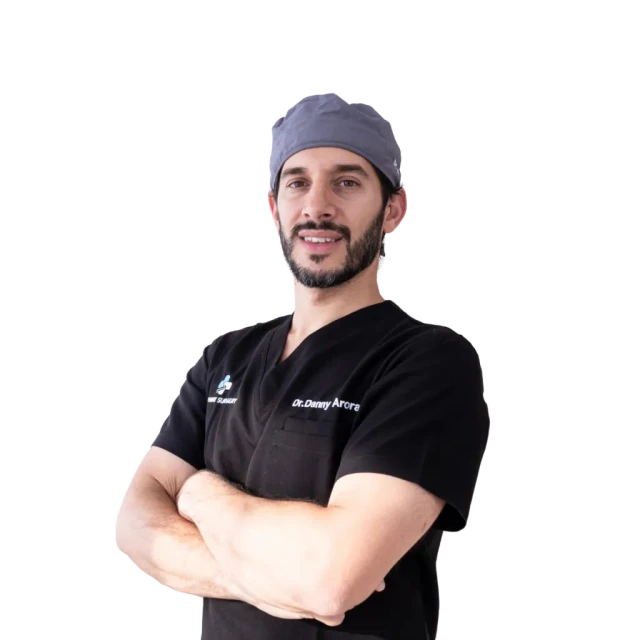
Fellowship-trained surgeon with expertise in foot and ankle arthroscopy.
For appropriate candidates, arthroscopy typically offers advantages including smaller incisions, less postoperative pain, and faster recovery. However, the best approach depends on your specific condition. Your surgeon will discuss whether arthroscopy is suitable for your case during your consultation.
Recovery time varies significantly based on the procedure performed. Simple procedures may allow return to normal activities within 1-2 weeks, while more complex procedures may require 4-8 weeks. Your surgeon will provide specific guidance based on your procedure and individual situation.
FLOW 50 with WEREWOLF COBLATION is an advanced ablation system that uses radiofrequency energy to remove tissue with precision while minimizing damage to surrounding structures. DYONICS blades are specialized cutting instruments designed for efficient tissue resection with reduced clogging. Together, they help your surgeon work efficiently and precisely.
No referral is required. You can book a consultation directly with our team to discuss your ankle condition. We recommend bringing any recent imaging to your appointment.
One of the primary benefits of arthroscopy is the use of very small incisions, called portals. These are typically less than 1cm long. As a result, scarring is generally very minimal and much less visible compared to the larger incisions required for traditional open surgeries.
While it is technically possible, surgeons usually advise against bilateral (both sides) ankle surgery in the same session. Having both ankles in the recovery phase simultaneously makes mobility and daily activities extremely difficult. It is generally safer and more effective to complete recovery on one side before proceeding with the other.
Next step
Start your care journey.
Schedule a consultation to discuss your ankle condition and explore whether arthroscopy is right for you. No referral required.